

Seeks HK$1.37 Billion as China’s Cobot Sector Hits Inflection Point
Guangdong Huayan Robotics Co., Ltd. — formerly known as Han’s Robot and rebranded in 2025 — has launched its global offering on the Hong Kong Stock Exchange Mainboard, seeking to raise HK$1.37 billion (approximately US$175 million) at HK$17.00 per H share. The company will begin trading under stock code 1021 on 30 March 2026, listing into the strongest Hong Kong IPO market since 2021.
The offering arrives at an inflection point for China’s collaborative robotics sector. Revenue at Huayan grew 77% year-on-year in 2024, reaching RMB 310.4 million, and the company swung to profitability that year after earlier losses. With a post-IPO market capitalisation of HK$9,035 million and strong cornerstone participation at 56% of the offer, the deal signals growing institutional confidence in China’s cobot buildout — even as near-term profitability in 2025 is expected to dip due to listing costs and accelerated R&D investment.
KEY FINANCIALS AT A GLANCE
| Metric | Figure |
| Revenue FY2022 | RMB 109.4 million |
| Revenue FY2023 | RMB 175.4 million |
| Revenue FY2024 | RMB 310.4 million |
| Revenue 9M 2025 | RMB 280.9 million (+36% YoY) |
| Revenue growth FY2024 YoY | 77% |
| Total equity (Sep 2025) | RMB 528.1 million |
| Cash & equivalents (Sep 2025) | RMB 101.2 million |
| Total liabilities (Sep 2025) | RMB 152.1 million |
| IPO Gross Proceeds | HK$1.37 billion (~US$175 million) |
| Offer Price | HK$17.00 per H share |
| Post-IPO Market Cap | HK$9,035 million (~US$1.16 billion) |
| Total H Shares Offered | 80,785,000 shares |
| Cornerstone Tranche | 45,265,800 shares (56% of offer) |
| Float (% of post-IPO capital) | ~15.2% (incl. over-allotment) |
| Global Cobot Market Size (2024) | RMB 7.5 billion |
Technology: Full-Stack Self-Development, Rooted in Han’s Laser Heritage
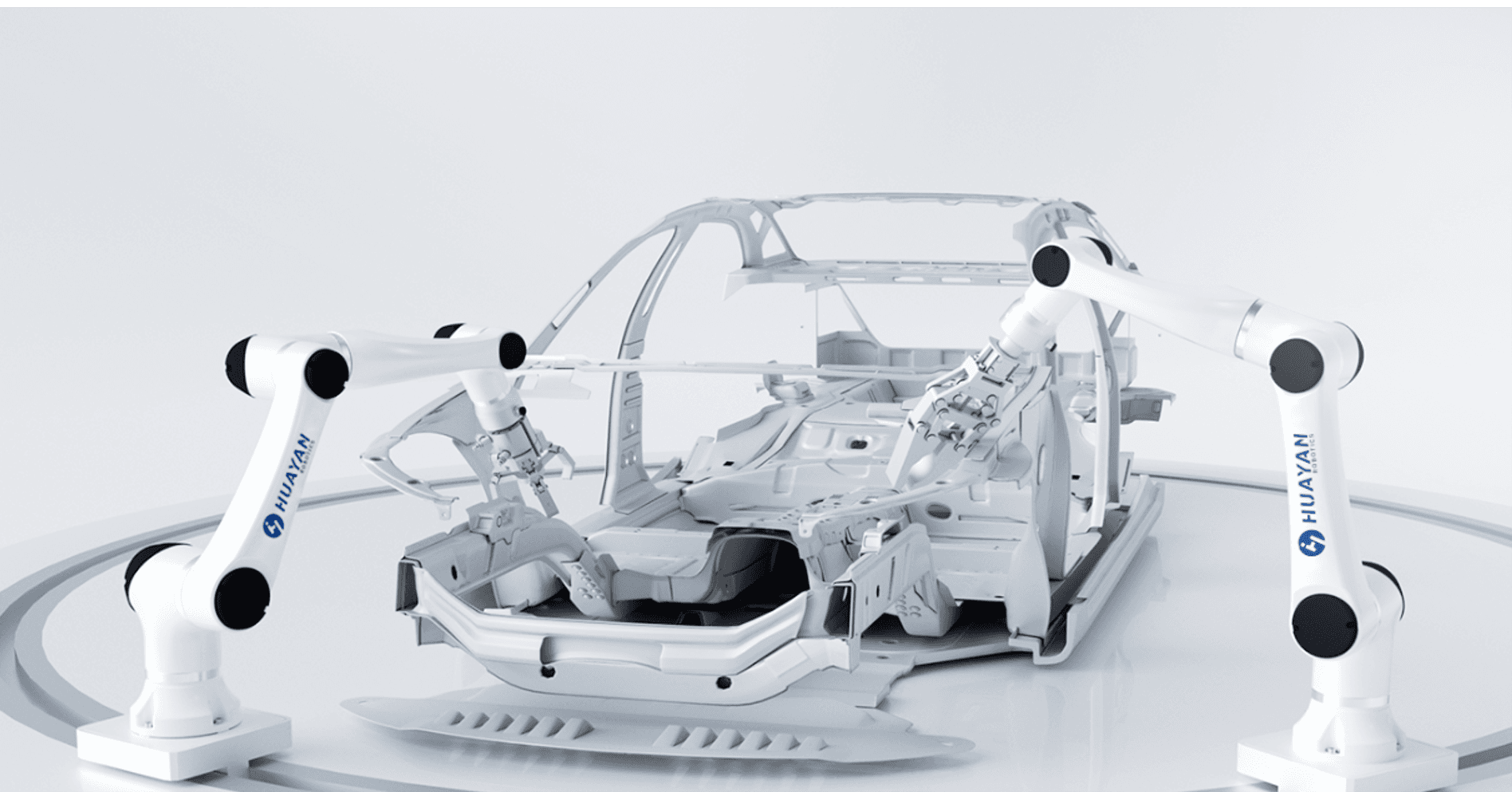
Huayan Robotics is the only domestic Chinese cobot brand that claims full independent development and in-house production of all core components — including harmonic reducers, motors, servo drives, encoders, robot controllers, and machine vision systems. That heritage traces directly to its parent organisation, Han’s Laser Technology Industry Group, a Shenzhen-listed precision manufacturing conglomerate founded in 1996 by Gao Yunfeng with a market capitalisation of approximately RMB 26 billion. Han’s Robot was established as a robotics subsidiary in 2017; the 2025 rebrand to Huayan Robotics marked the company’s pivot toward an internationally legible identity ahead of the listing.
The flagship Elfin series of 6-axis cobots spans payloads from 3 kg to 35 kg and underpins the company’s core industrial business. The Elfin-Pro variant adds integrated AI vision and force-control capabilities. The Elfin-Ex is certified for explosion-proof environments, opening chemical and petrochemical deployment. The newest S50 — a 50 kg rated, 60 kg max payload heavy cobot with 2,000 mm reach and 8.5 m/s end-effector speed — targets palletising, heavy material handling, and large-part assembly. Across these product lines, Huayan claims a payload-to-precision range unmatched by most domestic peers.
The company holds approximately 238 patents and has R&D and manufacturing bases in Foshan and Shenzhen, with subsidiaries and offices in Tianjin, Wuxi, Chengdu, Germany, and the United States. That distributed footprint positions it for the kind of localised service coverage industrial clients in automotive, electronics, healthcare, and logistics demand.
“Huayan Robotics is the only domestic brand whose core components are independently developed in China. Our cobots have been widely used in 3C, automotive, metalwork, and increasingly in new retail and direct consumer-facing applications.” — Company FAQ, Huayan Robotics
Market Position: Beneficiary of China’s Domestic Cobot Surge
The global collaborative robot market was valued at RMB 7.5 billion in 2024. China is by far the dominant production and consumption environment: domestic manufacturers now supply over 92% of the Chinese cobot market, up from a position of marginal share less than a decade ago. Huayan competes in this domestic-dominant pool alongside AUBO Robotics, Dobot, JAKA, Rokae, and Elite Robots, all of whom are targeting the same rapid-growth industrial automation wave.
Chinese robot exports broadly surged 60% in the first half of 2025, shipping 94,200 units to markets including Vietnam, Mexico, Thailand, and India. Huayan participates in this trend: the company’s products are sold to partners in over 100 countries and regions, with offices in Germany and the US to support regional sales and service. That international footprint is a key differentiator — most Chinese cobot competitors remain primarily domestic-facing.
The broader industrial robotics backdrop strengthens the demand thesis. China’s domestic robot deployments reached approximately 290,000 units in 2024, a 5% year-on-year increase even as other major economies declined. In 2024, 52% of industrial robots sold in China were made by domestic manufacturers, up from 47% in 2023 — a structural shift away from the historical dominance of the Japanese and European Big Four (FANUC, KUKA, ABB, Yaskawa). Cobots specifically are a subcategory where Chinese suppliers are especially competitive on price, customisation speed, and supply chain integration.
The cobot market itself is projected to grow from USD 1.97 billion globally in 2024 to USD 2.79 billion in 2025, with an estimated CAGR of 41.8% through 2033 — a trajectory that, if realised, would validate the capacity and R&D investment Huayan is making with IPO proceeds.
IPO Structure: Capital for Manufacturing Scale and Market Expansion
The offering comprises 80,785,000 new H shares at HK$17.00, split between a Hong Kong public offering of 4,039,400 shares (approximately 5%) and an international placing of 76,745,600 shares (approximately 95%). An over-allotment option and offer size adjustment option provide additional flexibility if demand warrants.
Cornerstone participation is the headline feature of the deal’s institutional story. Nine cornerstone investors committed to 45,265,800 shares — 56% of the total offer and 8.5% of post-IPO share capital. Named cornerstones include HHLRA, GF Fund, MSIP, Samson Group, Haojun Investment, Eternal Summer, Shrewd Pioneer, Richfirm, and VVC Technology. The breadth of this group — spanning domestic funds, institutional managers, and strategic investors — provides a credible signal of pre-listing conviction.
The implied post-IPO market capitalisation of HK$9,035 million (approximately US$1.16 billion) positions Huayan as a mid-cap listing in the Hong Kong robotics and automation universe, below leading A-share industrial robot names such as Estun (which trades at roughly HK$20–25 billion equivalent) but above most unlisted cobot peers. Whether international investors accept this pricing will depend on how they weight the company’s 77% revenue growth against the near-term net loss expected in 2025 and the unresolved questions around related-party revenue concentration.
The Structural Question: Related-Party Revenue and the Han’s Laser Overhang
The most analytically significant issue in the Huayan prospectus is one the company cannot fully resolve at listing: a material share of its revenue has historically come from Han’s Laser ecosystem customers. The prospectus acknowledges that related-party transactions have been a feature of the business — a function of its origins as a Han’s Laser spin-out and the continued procurement relationships within that group.
Smartkarma analyst commentary has specifically flagged this as the primary negative factor in the IPO thesis: the concentration of revenue in related-party channels raises questions about whether growth has been genuinely market-driven or partially supported by intra-group demand. For any investor seeking to underwrite the 77% revenue CAGR as a sustainable trend, the composition of that revenue matters as much as its headline rate.
The 2025 net loss expectation — driven by elevated R&D expenditure, share-based compensation, and listing costs — adds a near-term complexity. The company is making the right investments: accelerating product development, expanding the international distribution network, and building the infrastructure for sustained cobot and AI integration. But the path back to sustained profitability requires demonstrating that top-line growth is not contingent on the related-party channel.
“The most important question for any investor in Huayan Robotics is not whether cobots will grow. They will. The question is how much of that growth Huayan captures independently versus through the Han’s Laser distribution network — and whether those two things converge or diverge over time.”
Context: A Hot Market, a Buoyant Sector, and a Credible Timing Call
Hong Kong’s IPO market raised approximately US$11.64 billion in Q1 2026, up 385% from US$2.4 billion in Q1 2025. The exchange ranked as the world’s top listing venue in 2025 by total equity capital market fundraising, up 164% year-on-year. Huayan Robotics is one of five mainland companies that launched simultaneously on 20 March 2026, alongside AI vision, biotech, and healthcare services listings — evidence of a market that is actively absorbing Chinese technology and precision manufacturing stories.
Within that context, Huayan’s timing is well-judged. China’s 15th Five-Year Plan provisions for intelligent manufacturing and high-tech enterprise promotion provide a policy tailwind for domestic cobot adoption. Government procurement frameworks increasingly favour domestically certified manufacturers. The National ‘Little Giant’ Enterprise designation Huayan holds signals state-level recognition of its technology independence — an important credential in a political environment where supply chain sovereignty is a government priority.
Competitive pressure is real but manageable at Huayan’s current scale. Universal Robots (now owned by Teradyne) remains the global cobot benchmark on precision and ecosystem maturity. In the Chinese market, JAKA and Dobot are well-funded and aggressive. But Huayan’s full-stack vertical integration — and its claim of in-house motor and reducer development — gives it structural cost and customisation advantages that lighter-integration competitors cannot easily replicate.
The company is also participating in the global AI-in-robotics transition, albeit at a different altitude than a pure-play embodied AI company like Unitree. The Elfin-Pro’s AI vision and force-control integration is a near-term commercial feature, not a foundational model play. For the segment of the market focused on deployable industrial automation rather than frontier AI research, that distinction is a feature rather than a limitation.








Leave a comment