


Humanoid robots continue to dominate headlines, investment decks, and conference keynotes. Yet behind that momentum lies a more practical question for engineers, suppliers, and system integrators: which robotics sectors are already industrialized today, and which are quietly preparing the motion, actuation, and safety systems humanoids will ultimately depend on?
To address this, RobotToday separates the discussion into two axes: current market size and industrial maturity, and strategic relevance to humanoid motion systems before mass production. This article begins with the first axis, then reframes why exoskeletons—despite their smaller scale—play a disproportionate role in humanoid readiness.
Axis 1 — Market Size & Industrial Maturity (Today)
From an industrial perspective, several robotics sectors are already operating at scale, with established customers, proven supply chains, and repeatable deployment models.
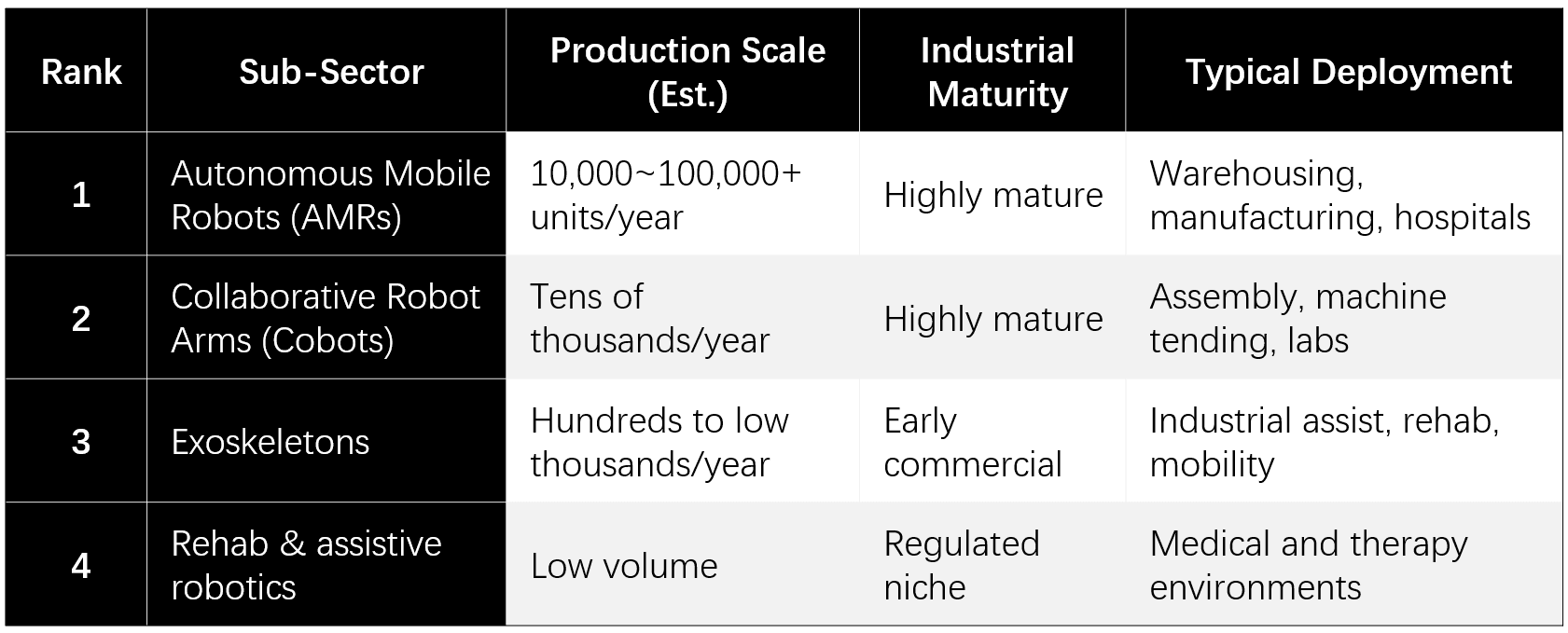
On this axis alone, the conclusion is clear. In today’s robotics economy, AMRs and cobots dominate revenue, deployment scale, and supply-chain maturity, placing them well ahead of exoskeletons in industrial significance—a reality any serious robotics analysis must acknowledge.
Why Market Size Alone Misses the Humanoid Question
Humanoid robots are not constrained primarily by navigation or basic manipulation. Their core bottlenecks lie in high-density joint actuation, sustained torque under human-scale loads, human-robot physical interaction safety, and wearable-class power and thermal limits. These challenges are only partially addressed by AMRs and cobots, which typically operate in structured environments with fixed bases or non-anthropomorphic locomotion.
This is where exoskeletons enter the picture—not as a large market, but as a strategic embodiment layer.
Exoskeletons: Small Market, Disproportionate Strategic Impact
Exoskeletons address a narrower problem than humanoids, but under far stricter physical constraints. They operate in direct contact with the human body, demand extremely low safety tolerance, and must deliver high torque within tight wearable power and thermal envelopes. The key difference is balance: exoskeletons rely on a human-in-the-loop model, while humanoids must solve full autonomous balance.
In effect, exoskeletons are humanoid motion systems with the balance problem outsourced to the human body. This makes them the first real-world deployment environment for humanoid-grade joint modules, compliant actuation, human-safe impedance control, and wearable power management. These technologies are not theoretical here—they are being deployed, stressed, and iterated in real use.
Exoskeletons at CES 2026: Signal, Not Scale
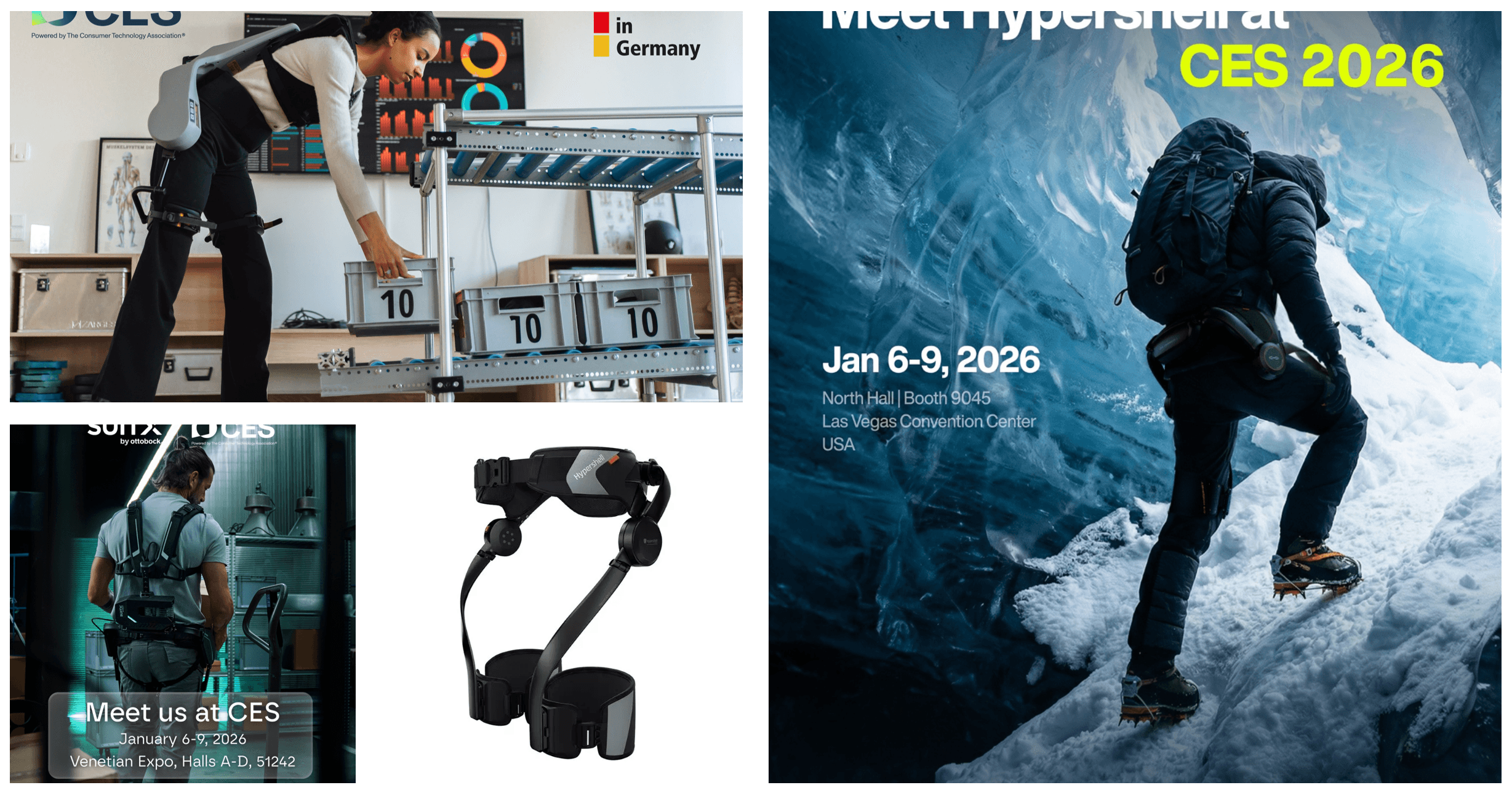
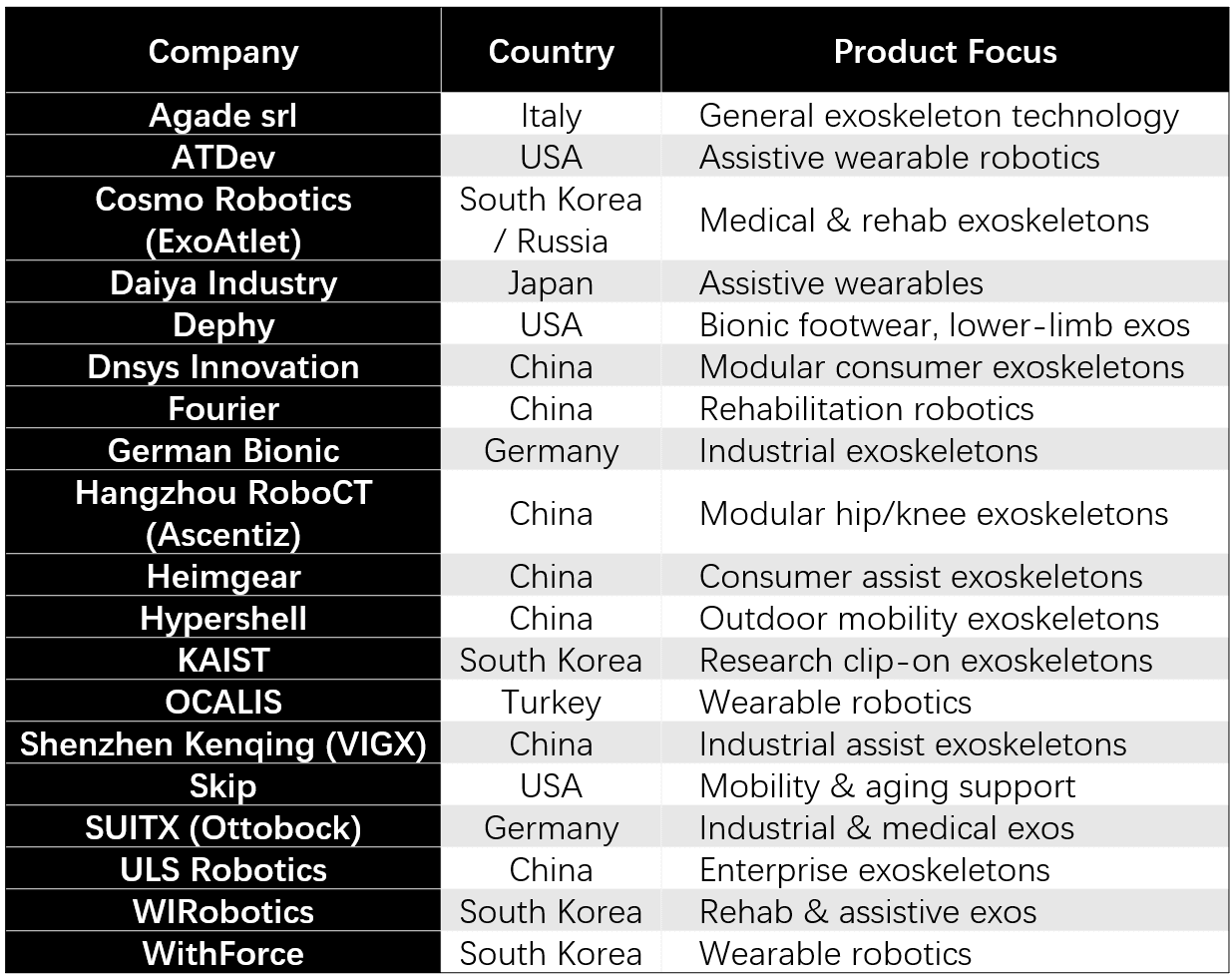
CES is not a measure of market size, but it is a reliable early indicator of directional momentum. Viewed through that lens, the exoskeleton sector’s trajectory from CES 2024 to CES 2026 stands out. Exoskeletons still account for only a small share of total robotics exhibitors, yet their visibility has increased rapidly—from an estimated 7–8 exhibitors at CES 2024, largely focused on industrial and medical use cases, to roughly 12 in 2025 and 19 in 2026. This represents approximately 58% year-over-year growth from 2025 to 2026 and 150–170% growth compared with 2024. In absolute terms, exoskeletons comprise only about 3% of robotics exhibitors at CES 2026, but in relative terms they are among the fastest-growing embodiment sub-sectors on the show floor.
Innovation recognition reinforces this momentum. Exoskeleton-related CES Innovation Award honorees increased from around three in 2024 to about five in 2025 and at least seven in 2026, including several multi-category winners. This corresponds to roughly 40% growth versus 2025 and more than 130% growth versus 2024, signaling a transition from prototype validation toward product readiness, particularly in lower-limb and modular systems.
The key signal from CES 2026 is not an imminent market breakout—volumes remain modest relative to AMRs and cobots—but accelerating subsystem convergence. Exhibited systems increasingly emphasize shared joint architectures, modular hip and knee units, tighter actuator integration, and AI-assisted intent detection, torque control, and energy management. Chinese vendors now represent an estimated 35–40% of exoskeleton exhibitors, reflecting rapid iteration cycles and early cost-down efforts, while application scope continues to expand from rehabilitation and logistics into consumer mobility and outdoor endurance. In this sense, CES reflects not scale, but the early industrialization of humanoid-relevant motion systems within smaller, wearable, human-in-the-loop platforms.
Core Technical Components Where Exoskeletons Lead Humanoid Readiness
The strategic value of exoskeletons lies in how they force early industrialization of humanoid-grade subsystems under real-world constraints. CES 2026 highlights five component areas where this effect is most visible.
Actuators and Joint Modules: Lightweight Torque Under Wearable Constraints
Actuation remains the primary bottleneck for humanoid scalability, and exoskeletons provide a rare environment where high torque, compliance, and low mass must coexist. Systems exhibited at CES 2026 increasingly favor mechanically efficient joint designs—such as cable-drive and series elastic actuators—over rigid, motor-dominated architectures. By exploiting torque amplification through geometry (τ = F × r), these designs deliver 10–50 Nm per joint while keeping joint mass near or below 1 kg.
Compliance introduced through elastic elements reduces shock loads, improves safety, and enables sustained operation under dynamic human interaction. These characteristics closely match humanoid requirements for load handling and balance recovery, making exoskeleton deployments a practical proving ground for actuator concepts humanoids will eventually require at scale.
Sensors and AI for Intent Detection and Adaptive Control
Exoskeletons must infer human intent in real time and respond within tight latency limits. CES 2026 systems increasingly rely on multi-sensor fusion—combining IMUs, joint encoders, and in some cases EMG—processed by lightweight machine-learning models to predict gait phase and motion intent. Reported response latencies are approaching sub-50 ms, with measurable reductions in user effort and energy consumption.
Control architectures increasingly resemble humanoid impedance and admittance models, where force response follows formulations such as F = mẍ + bẋ + kx. The difference is that exoskeletons benefit from human-in-the-loop stabilization, allowing aggressive tuning and rapid iteration. The resulting datasets and control strategies are directly transferable to humanoid locomotion and whole-body coordination.
Power Management and Thermal Constraints in Wearable Systems
Power density and thermal management are persistent failure points for humanoids, and exoskeletons already operate near these limits. CES 2026 systems typically target sub-200 Wh battery packs while achieving 4–6 hours of mixed-use operation. This is enabled through high-efficiency motors, energy-aware control, and regenerative braking that recovers a portion of energy during stance and deceleration.
Thermal constraints are equally strict. Continuous skin contact requires surface temperatures below ~40°C, sharply limiting sustained current and heat dissipation. These constraints force early adoption of duty-cycle optimization, distributed thermal design, and power-aware motion planning—capabilities humanoids will need once untethered operation becomes mandatory.
Modular Architectures: Toward Plug-and-Play Motion Systems
Modularity emerged at CES 2026 as a defining architectural trend. Swappable hip and knee units, standardized electrical interfaces, and software-defined torque profiles allow faster iteration and simplified maintenance across exoskeleton platforms. This reduces integration friction and supports configuration changes without redesigning entire systems.
For humanoids, modular joint architectures enable parallel development, faster failure isolation, and scalable manufacturing. Exoskeletons are already validating these concepts in environments where reliability, uptime, and user comfort are immediate concerns rather than future design goals.
Safety and Impedance Control: Designing for Failure
Because exoskeletons operate in direct physical contact with humans, safety is a first-order design constraint. CES 2026 systems demonstrate conservative torque limits, structured fault detection, and impedance control as baseline requirements rather than optional features. Joint output is commonly capped at 70–80% of human capacity, prioritizing predictable behavior over peak performance.
Many platforms now incorporate sensor redundancy, fallback control modes, and rapid disengagement mechanisms. These safety patterns map directly onto humanoid requirements, where uncontrolled force application poses significant risk. Exoskeletons therefore function as early testbeds for the functional safety logic humanoid systems will eventually need to certify.
Reconciling the Two Axes
Taken together, the picture becomes clear. AMRs and cobots dominate today’s robotics economy, driving manufacturing scale, cost reduction, and supply-chain maturity. Exoskeletons operate at smaller scale, but they force humanoid-grade motion systems into real deployments first, under tighter physical and safety constraints.
This leads to a critical insight: humanoid robots will not industrialize directly. They will inherit hardened subsystems from sectors already shipping, and exoskeletons are where the hardest motion problems are being solved ahead of mass humanoid deployment.
Closing Perspective
Humanoids remain the convergence point of robotics ambition. But before they scale, the industry is already paying the learning costs elsewhere. AMRs and cobots build industrial muscle. Exoskeletons build embodied intelligence. Understanding the difference is essential for anyone seeking to distinguish signal from scale in the robotics industry.










Leave a comment