

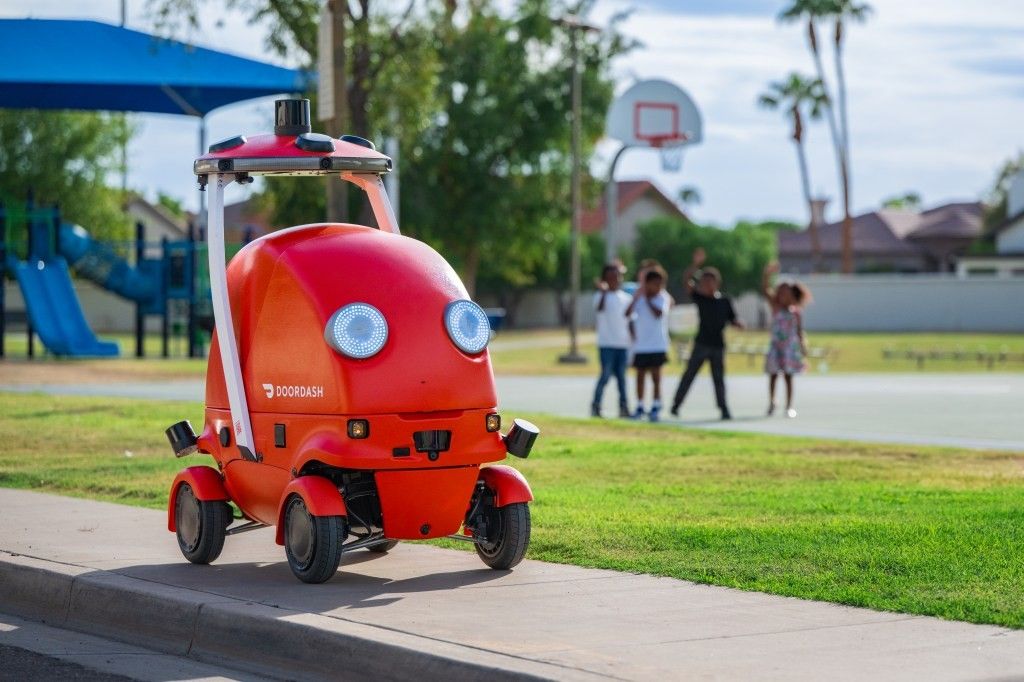
SAN FRANCISCO – September 30, 2025 – DoorDash has officially entered the autonomous vehicle race with the unveiling of Dot, its first commercial, in-house-built autonomous delivery robot. Designed for local commerce, Dot can travel seamlessly on roads, bike lanes, and sidewalks at speeds up to 20 miles per hour, a significant leap in capability over traditional sidewalk robots. The company is already piloting Dot with early access partners in the Phoenix metropolitan area and plans to make it available to the region's 1.6 million residents by the end of 2025.
Built for the 'First and Last Ten Feet'
While the move pits DoorDash against AV giants like Waymo and Tesla, the company argues that Dot's unique form factor is key to conquering the massive market for small, fast deliveries. "You don't always need a full-sized car to deliver a tube of toothpaste or pack of diapers," said Stanley Tang, DoorDash Co-founder and Head of DoorDash Labs, at the San Francisco headquarters event. He emphasized that Dot is purpose-built for the millions of daily deliveries that require navigating tight spaces—a challenge known as "the first and last ten feet."
| Feature | Details |
| Speed | Up to 20 mph |
| Size | Less than 5 feet tall; roughly one-tenth the size of a car; 350 lbs. |
| Cargo Capacity | Up to 30 pounds or six large pizza boxes |
| Design | Bright red, four-wheeled, "cartoonish" appearance with LED eyes/mouth. |
| Navigation Stack | Eight external cameras, four radar, and three lidar sensors powered by a real-time AI model. |
| Power | Fully electric, runs on an interchangeable battery. |
Dot’s design features a mouth that swings open to reveal a configurable cargo space, equipped with inserts for items like cupholders and coolers. An internal camera monitors food quality and ensures security.
Strategy and Safety Hurdles
The robot is a product of seven years of internal development, including the 2019 acquisition of AV startup Scotty Labs. Ashu Rege, VP and Head of Autonomy at DoorDash Labs, noted that early conversations with city and state officials have been positive, with many seeing small-vehicle delivery as a way to reduce traffic congestion.
Dot is one piece of DoorDash's new Autonomous Delivery Platform, an AI-powered dispatcher that coordinates orders across human Dashers, robots, and future drone deliveries. DoorDash maintains that human workers will still fulfill the vast majority of orders, with automation allowing them to focus on "high-value orders that require human judgment and care." The company is keenly aware of the safety and public perception hurdles that have plagued the AV industry. If Dot encounters an issue, it is trained to pull over and wait; it cannot be remotely operated by humans. A dedicated support ecosystem—including warehouses, charging stations, and field operators—has been established in Phoenix to maintain, clean, and rescue the fleet when necessary.
As autonomous delivery heats up, Dot represents DoorDash's most ambitious strategic bet on solving real-world logistical challenges and reshaping its competitive position against rivals like Uber and Instacart.








Leave a comment