


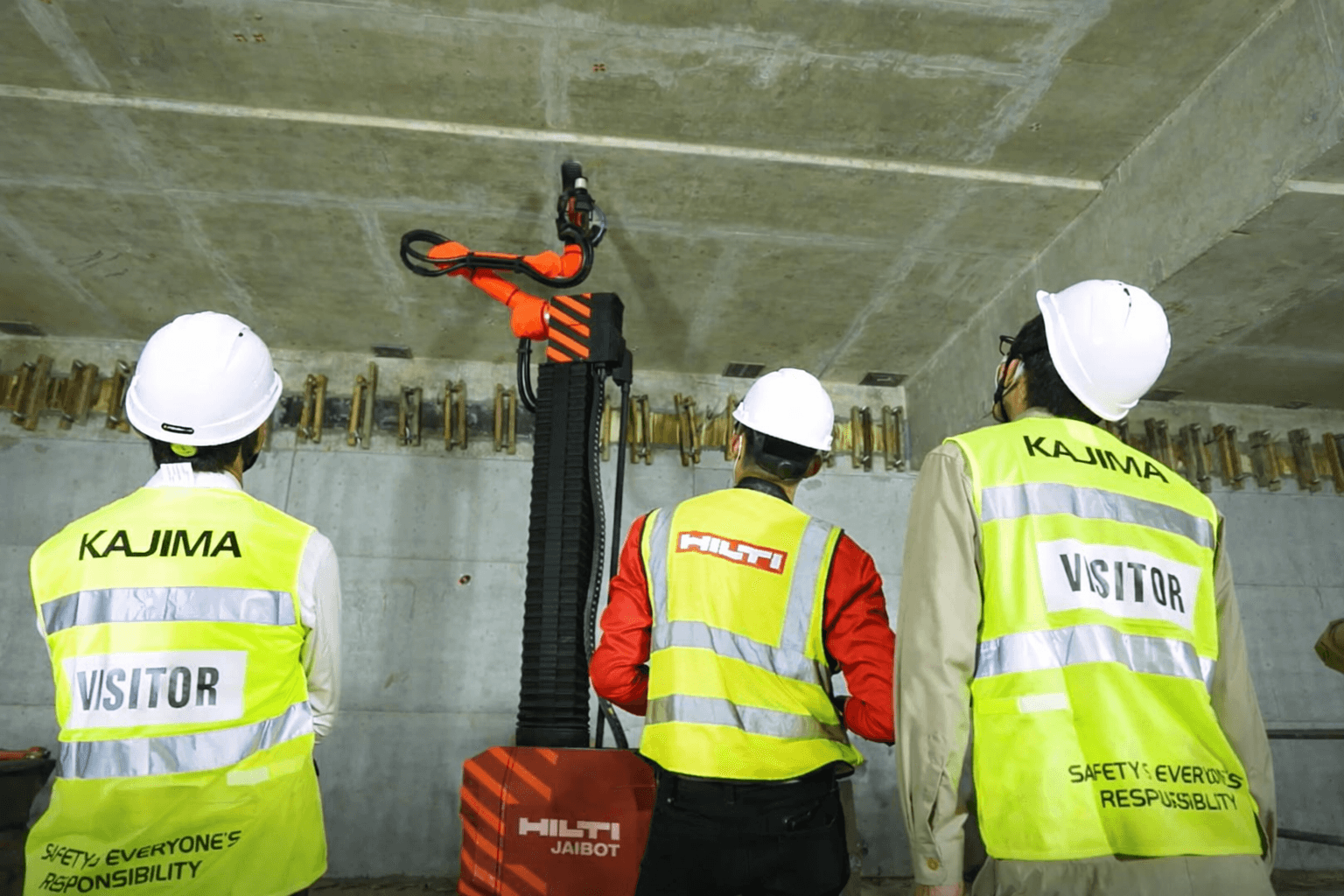
Rebar tying robots cut labor time by 70%. Concrete finishing robots are growing at 17% CAGR. The structural segment is where automation ROI is clearest — and fastest.
THE LARGEST SEGMENT. THE CLEAREST ROI.
Concrete and structural work is the largest application segment in construction automation. It covers the heaviest, most repetitive, and most injury-prone tasks on any job site. Rebar installation, concrete pouring, surface finishing, and ceiling drilling account for a massive share of total labor hours.
The robotic concrete finishing market was valued at $1.62 billion in 2025. It is projected to reach $3.59 billion by 2030. That is a 17.2% compound annual growth rate, per Research and Markets (January 2026). This is not a forecast based on theoretical demand. It reflects active deployment across data centers, bridges, high-rises, and infrastructure projects.
Three forces are aligning simultaneously. Labor shortfalls are deepening. Project complexity is increasing. AI and sensor hardware have matured enough to function reliably on unstructured job sites.
The result: automation in concrete and structural work is moving from pilot to standard practice. The question is no longer whether it works. It is who adopts it fast enough to survive margin compression.
| Segment | 2025 Market Size | 2030 Projection | CAGR |
|---|---|---|---|
| Robotic Concrete Finishing | $1.62 billion | $3.59 billion | 17.2% |
| Rebar Automation (global) | Emerging | Rapid expansion | ~20%+ |
| MEP Drilling / Interior Robots | Emerging | Scaling commercially | High |
| Total Construction Robotics | ~$3B+ | $15–20B est. | ~25%+ |
Source: Research and Markets (January 2026) for concrete finishing segment. Rebar and total robotics figures are industry estimates and have not been independently verified by a governmental body.
THE INJURY MATH BEHIND THE MARKET
OSHA data shows that 61% of construction accidents involve rebar. This is not a marginal risk. Rebar installation requires workers to bend repeatedly, carry heavy steel bundles, and work at heights with exposed sharp ends.
The ergonomic burden compounds the safety risk. A full bridge deck requires thousands of individually tied intersections. A single ironworker bends over repeatedly for hours. Musculoskeletal injuries accumulate over careers. Replacing this labor is not just an efficiency play. It is a safety imperative backed by insurance and liability economics.
According to peer-reviewed research published in Construction Robotics (2024), construction robots reduced time on hazardous tasks by 72% on average across twelve documented projects. That statistic alone reframes the automation investment from a cost item to a risk management decision.
61% of construction accidents involve rebar, per OSHA. Automation here is not efficiency theater — it is risk elimination.
THE KEY PLAYERS: DEEP PROFILES
1. Advanced Construction Robotics — TyBOT & IronBOT
Founded: 2016 | HQ: Pittsburgh, PA | Products: TyBOT, IronBOT | Status: Commercially deployed across North America
Advanced Construction Robotics (ACR) built the world's first commercially deployed rebar-tying robot. TyBOT requires no pre-programming, no BIM input, and no digital site mapping. It self-locates, self-positions, and self-ties more than 1,200 rebar intersections per hour. It runs day or night, in rain or shine, powered by an onboard generator for 12 continuous hours.
The ROI data from real projects is documented. On a bridge project in Louisiana, TyBOT reduced ergonomically challenging bending tasks by 72%. Rework dropped from 5% to under 3%. Waste from improper ties fell to zero.
IronBOT, ACR's second robot, handles the lifting and placing problem. It lifts bundles of up to 5,000 pounds and places rebar with no heavy lifting from crew members. IronBOT can handle bridge decks from 10 to 117 feet wide, placing bars 9 to 60 feet long.
The "Bot Bundle" — TyBOT and IronBOT working together — cut rebar installation on the St. Lucie West Boulevard bridge from 14 to 6.5 production shifts. That is a 50% schedule reduction on a real $15.5 million infrastructure project. Per ACR, the combined productivity increase exceeds 250%. These figures originate from ACR and contractor Shelby Erectors and have not been independently verified by a third party.
| Metric | TyBOT Performance | Source / Note |
|---|---|---|
| Ties per hour | 1,200+ | ACR company data. Not independently verified. |
| Labor ergonomic reduction | 72% (bridge) | Springer Construction Robotics, 2024 (peer-reviewed) |
| Rework reduction | 40% (5% to ~3%) | Same peer-reviewed study |
| Material waste | 2% to 0% | Same peer-reviewed study |
| Schedule reduction (Bot Bundle) | ~50% | ACR / Shelby Erectors project data. Self-reported. |
| Productivity increase (Bot Bundle) | 250%+ | ACR company claim. Not independently verified. |
2. Hilti — Jaibot Drilling Robot
Founded: 1941 | HQ: Schaan, Liechtenstein | Product: Jaibot | Status: Commercial deployment since 2020, now used globally by major contractors
Hilti's Jaibot is the most commercially proven construction robot currently deployed at scale. It drills anchor holes in concrete ceilings for MEP (mechanical, electrical, and plumbing) installations. It operates directly from BIM data. No expertise is required from the operator.
The Jaibot has a five-axis telescopic robotic arm, laser-guided orientation, and an onboard dust removal system. It runs cordlessly for up to 8 hours per charge. One operator drives it between work zones. The robot drills all holes within a 6-foot diameter autonomously.
Hilti claims productivity 5 to 10 times higher than manual overhead drilling. On one Colorado project at the National Renewable Energy Laboratory, a single operator using Jaibot achieved 300 holes per day. Manual apprentice performance would be substantially lower. These productivity claims originate from Hilti and field operators and have not been independently audited.
The 2022 update added corrugated metal deck ceiling capability, concrete wall drilling at heights from 0.9 to 4.8 meters, 30% higher dust extraction, and improved BIM data integration. Major contractors including Skanska, Bouygues, and De Groot have deployed Jaibot globally.
| Feature | Specification |
|---|---|
| Arm reach (ceiling height) | 8.5 to 16.5 feet |
| Drill diameter range | 3/16 to 3/4 inch (standard MEP sizes) |
| Battery runtime | Up to 8 hours per charge |
| Productivity vs. manual | 5 to 10x (Hilti claim; not independently verified) |
| BIM integration | Revit, AutoCAD via Hilti Cloud |
| Operators required | 1 (non-expert) |
| Wall drilling | 0.9 to 4.8 meters height (post-2022 update) |
3. Shimizu Corporation — Smart Site & Robo-Series (Japan)
HQ: Tokyo, Japan | Program: Shimz Smart Site | Status: Deployed on high-rise projects in Osaka and Tokyo
Shimizu is Japan's most advanced large contractor in robotics integration. Its Smart Site program deploys a coordinated fleet of AI-enabled robots on high-rise construction sites. The goal is human-robot collaboration, not full replacement.
Three core robots operate within the Smart Site system. Robo-Carrier transports materials horizontally using BIM-based navigation and obstacle avoidance. Robo-Welder uses a six-axis robotic arm with laser shape measurement to perform structural column welding — tasks typically requiring multiple skilled workers. Robo-Buddy installs ceiling boards, using dual robotic arms to lift and fasten panels autonomously.
Shimizu invested approximately 30 million USD in robotics R&D for the Smart Site initiative. The system was first deployed in Osaka in 2018. Full commercial deployment across multiple Tokyo high-rise sites followed.
The productivity and waste outcomes are documented from earlier related systems. Shimizu's SMART building factory system from the 1990s documented a 70% reduction in construction waste on buildings where it was deployed. The newer Smart Site builds on this foundation with AI, BIM integration, and improved autonomy.
4. Kajima Corporation — Autonomous Concrete Finishing (Japan/Singapore)
HQ: Tokyo, Japan | Product: Autonomous Concrete Finishing Robot | Status: Award-winning deployment in Singapore (2025)
Kajima's Autonomous Concrete Finishing Robot won the Award for Most Transformational Collaboration at the 2025 SICC Awards in Singapore. The robot was jointly developed with Kajima Technical Research Institute Singapore (KaTRIS) and government developer JTC Corporation.
The robotic concrete finishing market, where Kajima and Shimizu are major players, is projected to grow at 17.2% CAGR from 2025 to 2030, reaching $3.59 billion. Kajima's multi-machine control system maintains productivity with lean crews — a critical competitive advantage as Japanese construction labor shortages worsen.
Earlier Kajima systems established precedent. The AMURAD fully automated building construction system in the 1990s was the world's first attempt at fully roboticized high-rise construction. Modern systems benefit from AI, lower hardware costs, and decades of accumulated engineering insight.
5. XCMG — China's Intelligent Construction Ecosystem
HQ: Xuzhou, Jiangsu, China | Scale: World's 3rd largest construction machinery manufacturer | Status: Large-scale AI integration across product lines
XCMG operates differently from the other players in this analysis. It is not deploying a single specialist robot. It is building an intelligent ecosystem across its entire product range — cranes, excavators, drilling rigs, and concrete machinery.
XCMG allocated 6.11% of 2024 revenue to R&D, per company disclosure. Its X-Dragon AI platform enables real-time data analysis, predictive maintenance, and autonomous equipment operation. Unmanned mining trucks are already running 24-hour operations in open-pit mines. Unmanned loaders have been demonstrated across multiple sites.
At bauma CHINA 2024, XCMG showcased four intelligent construction scenarios, including fully autonomous concrete handling solutions. The event generated nearly 10 billion RMB in intended orders over four days. XCMG's overseas revenue reached 45.48% of total sales in 2024, up from 40.09% in 2023. These figures originate from XCMG company disclosures and have not been independently verified by a third party.
China's construction robotics market operates as a separate ecosystem from the Western market. State-directed investment, domestic procurement structures, and scale manufacturing create a different competitive dynamic. XCMG's intelligent welding robots are actively deployed on construction sites. Its PCR300 demolition robot — 2 tons with the demolition power of a 6-ton excavator — represents the density of innovation in the Chinese market.
THE AI AND ROBOTICS CONVERGENCE DRIVING THIS SEGMENT
Computer Vision Matures for Unstructured Environments
The fundamental barrier to construction robotics was always unstructured environments. Factory robots work in fixed, predictable settings. Construction sites are dynamic, variable, and often unpredictable.
Modern computer vision systems have closed this gap. TyBOT uses a stereo camera system to find rebar intersections in real time with no pre-mapping. Canvas's drywall robot detects wall surfaces and seam positions without blueprints or pre-scans. Hilti Jaibot detects obstacles and adjusts its drilling path automatically.
These systems work because AI training data and model accuracy have improved dramatically. TyBOT's camera system achieves sufficient accuracy to eliminate the need for any BIM input — a simplification that directly enables field deployment without expert setup.
Large Language Models Enter Construction Planning
Generative AI is beginning to influence the planning and coordination layer. BIM-integrated robots now receive real-time updates when design changes occur in the cloud. Scheduling optimization tools are reducing idle time between robotic tasks.
McKinsey's October 2025 analysis of humanoid robots in construction noted that funding for general-purpose robots grew fivefold from 2022 to 2024, exceeding $1 billion annually. The analysis estimated the general-purpose robotics market could reach $370 billion by 2040. Most funding flows to US and Chinese companies.
For concrete and structural work, the near-term AI impact is integration, not humanoid replacement. AI is coordinating task sequencing, detecting quality deviations, and enabling robots to adapt to site variability. This raises the value of existing specialist platforms like TyBOT and Jaibot without requiring new hardware.
JLG Acquires Canvas: The Industrial Consolidation Signal
JLG Industries, a division of Oshkosh Corporation, acquired Canvas in January 2026 for an undisclosed sum. Canvas had deployed robots finishing nearly one million square feet of drywall.
JLG's rationale was explicit: pair Canvas's AI-driven robotic finishing with JLG's lift access equipment. The vision is a combined system where workers on the ground control swarms of robots working at height.
Canvas reduced drywall finishing time from five to seven days to approximately two days. It cut labor requirements by 40% per job. Training time dropped from four years of apprenticeship to four months. This acquisition signals that established equipment manufacturers see construction robotics as core to their product roadmap — not a peripheral experiment.
| Company | Product | Key Stat | AI/Tech Core |
|---|---|---|---|
| ACR | TyBOT / IronBOT | 72% ergonomic reduction (peer-reviewed) | Computer vision, autonomous navigation |
| Hilti | Jaibot | 5–10x productivity vs. manual (Hilti claim) | BIM integration, 5-axis arm, laser guidance |
| Shimizu | Smart Site / Robo-series | 30M USD R&D investment (company disclosure) | AI + BIM coordination, fleet management |
| Kajima | Concrete Finishing Robot | 2025 SICC Award winner | Autonomous surface detection |
| Canvas / JLG | 1200CX Drywall Robot | 60% schedule reduction (company claim) | AI vision, no pre-mapping required |
| XCMG | Intelligent construction ecosystem | 45.48% overseas revenue 2024 (company disclosure) | X-Dragon AI, autonomous equipment |
THE CHALLENGES: WHY ADOPTION IS STILL SLOWER THAN THE MARKET NEEDS
Site Variability Remains the Primary Technical Barrier
Construction sites change daily. Material deliveries, weather, design revisions, and trade sequencing create conditions that static programming cannot handle. The robots that are succeeding in the market — TyBOT, Jaibot, Canvas — all share one design principle: they require minimal pre-setup and adapt to site conditions in real time.
Robots designed for fixed conditions fail in the field. The historical graveyard of construction robotics, including Japan's 1990s automated building factories, is littered with systems that required extensive setup, pristine conditions, and specially designed buildings. None scaled commercially.
Upfront Capital and Business Model Friction
TyBOT and IronBOT are rental-based in many deployments. Jaibot pricing is structured around project needs, not a standard purchase. Canvas was acquired by JLG, which has established equipment rental channels.
Contractors operate on 7% average margins globally, per Turner and Townsend. Capital for robotic equipment competes directly with operational cash flow. Rental and robotics-as-a-service models reduce the adoption barrier. But financing infrastructure for construction robotics remains underdeveloped compared to agricultural or industrial automation.
Workforce Integration and Union Dynamics
Canvas built its go-to-market around union collaboration. Development and testing happened inside International Union of Painters and Allied Trades training facilities. The result: faster adoption and less resistance from organized labor.
This approach is not universal. Many robotic deployments still face skepticism from crews who see automation as a job threat. The evidence suggests the opposite outcome in practice. TyBOT deployments have consistently maintained crew sizes while improving per-worker output and safety. The productivity gain comes from augmentation, not replacement.
Japan's Advanced Systems: High Performance, Hard to Scale
Shimizu's Smart Site is genuinely advanced. It coordinates multiple AI-enabled robots on high-rise sites with BIM integration. But the system requires extensive upfront coordination and works best when the building design accommodates robotic workflows.
Kajima's earlier AMURAD system calculated a payback period of approximately 8 buildings — meaning up to 20 years before positive ROI in some scenarios. Modern systems are faster to deploy and cheaper to operate. But the scaling challenge that plagued 1990s Japanese automated construction has not fully disappeared.
THE ROI CASE FOR HIGH-RISE MARKETS
Concrete automation delivers its fastest ROI in high-rise and large-scale infrastructure markets. The arithmetic is straightforward.
Labor represents 40 to 60% of total construction costs. Skilled trades wages are rising 5 to 7% annually. A project with 100,000 square feet of rebar work that reduces labor time by 50% through the Bot Bundle recovers the robot rental cost within the project itself.
The compounding factor is schedule compression. Every day of accelerated completion on a large data center, semiconductor fab, or high-rise reduces financing costs, delays in occupancy revenue, and project management overhead. TyBOT's ability to work day and night without fatigue delivers this compression consistently.
For drywall in data centers, Canvas has made the case directly: hyperscale data centers require 2 to 4 times the capacity built over the past 25 years — in just the next five years. Drywall finishing is on the critical path for commissioning. Robots that compress that schedule by 60% have outsized ROI in this specific market context.
Schedule compression on a $500M data center or semiconductor fab generates returns that dwarf robot rental costs. This is where automation ROI is clearest.
KEY FINDINGS AT A GLANCE
| Finding | Implication |
|---|---|
| Robotic concrete finishing grows at 17.2% CAGR through 2030 | Market growth is validated, not speculative |
| TyBOT cuts ergonomic rebar hazard by 72% (peer-reviewed, 2024) | Safety ROI is documented and insurable |
| Bot Bundle cuts schedule by ~50% on real bridge projects | Infrastructure owners have a proven tool now |
| Hilti Jaibot is 5–10x more productive than manual drilling (Hilti claim) | MEP automation is already at commercial scale |
| JLG acquires Canvas in January 2026 | Industrial equipment makers see robotics as core product |
| XCMG overseas revenue: 45.48% in 2024 | China's intelligent construction is already global |
| Humanoid robot investment 5x from 2022 to 2024 | The next generation of adaptable site robots is funded |
Note: Productivity and ROI figures marked as company claims originate from manufacturer or contractor disclosures. They have not been independently verified by governmental statistical bodies or third-party auditors. Peer-reviewed citations indicate independently published research.
SOURCES & METHODOLOGY NOTE
Primary sources: Research and Markets (Global Robotic Concrete Finishing Market Report, January 2026), Springer Construction Robotics (peer-reviewed study on safety, quality, schedule, and cost impacts of ten construction robots, May 2024), Advanced Construction Robotics (ACR) company data, Hilti Group product disclosures, Shimizu Corporation company communications, Kajima Corporation technical institute releases, XCMG Machinery 2024 annual disclosures, JLG / Oshkosh press release (January 2026), McKinsey Global Institute (Humanoid Robots in Construction, October 2025), Engineering News-Record, BuiltWorlds 2025 Robotics Top 50, Bureau of Labor Statistics (BLS), Turner & Townsend ICMS 2024.
Where data originates from company press releases, self-reported contractor testimonials, or manufacturer performance claims, this has been noted inline with the phrase 'company claim' or 'not independently verified.' Peer-reviewed and governmental sources are distinguished in citations.







Leave a comment