


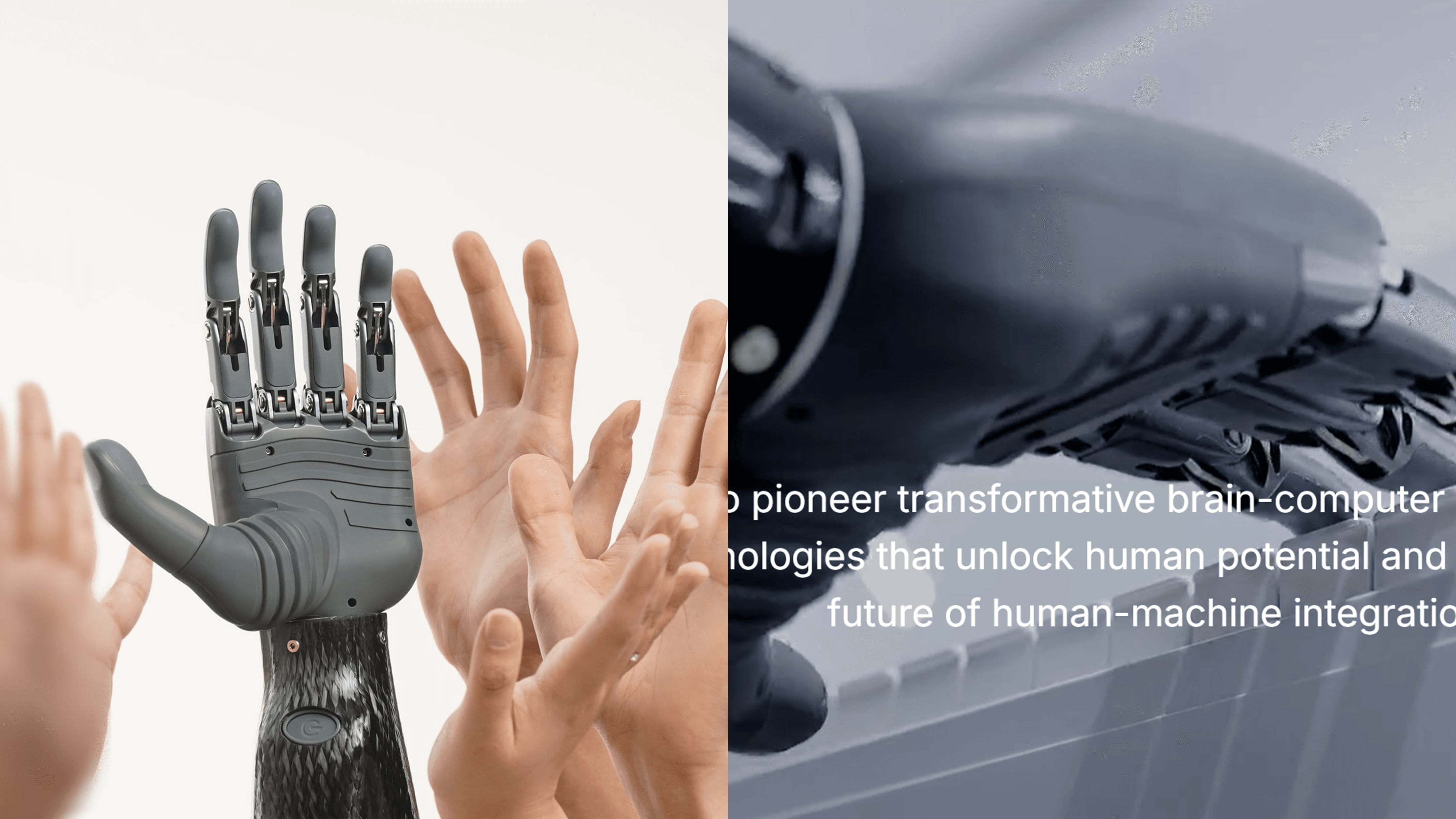
The Hangzhou BCI specialist's third-generation robot hand pairs full-palm tactile sensing with visuotactile fingertips and a fully direct-drive architecture — claiming world-first status among open-ecosystem hands above 20 degrees of freedom.
| QUICK TAKE |
|
From Prosthetics to Platforms
BrainCo — the Hangzhou-based brain-computer interface company sometimes grouped among China's so-called "Six Little Dragons" — has launched Revo 3, its third-generation robot dexterous hand. The announcement, made on 10 April 2026, positions the product as the world's first open-ecosystem dexterous hand combining more than 20 degrees of freedom with full-palm tactile sensing and visuotactile fingertip perception.
The launch follows a trajectory that is unusual in the dexterous-hand sector. BrainCo's entry point was not industrial automation but disability medicine: the company's intelligent prosthetic hand was named to Time magazine's list of the 100 best inventions of 2019, and years of fitting amputees with functional prostheses forced the engineering team to confront the full complexity of hand mechanics — tendon routing, force transmission, tactile feedback loops — long before the humanoid robot boom created commercial demand for such solutions.
That prosthetics heritage now underpins what the company describes as a deliberate technology transfer. The first robot dexterous hand launched in March 2024; a tactile-enabled version followed five months later; and the Revo 2 series — offered in Basic, PRO, and TOUCH configurations — was deployed across dozens of leading Chinese robotics companies by April 2025. Revo 3 represents the third step in that two-year sprint.
The 21-DOF Decision
Degree-of-freedom count remains one of the most debated design parameters in dexterous hand engineering. Shadow Robot's hand reaches 24 DOF; Tesla's Optimus hand ships with 22. BrainCo's decision to land at 21 active DOF is presented not as a compromise but as a deliberate optimisation informed by iterative testing.
According to BrainCo, performance improvements from increasing DOF are broadly linear through the low-teens range, but a step-change in manipulation capability occurs at the transition from 20 to 21 DOF — at which point previously structurally impossible motions become executable. Beyond 21, the company's engineers found that incremental gains in dexterity were outweighed by rising control complexity and cost. The 21 active DOF in Revo 3 are distributed as four degrees per finger across four fingers, with five degrees on the thumb, replicating the 21 DOF of the human palm. BrainCo states that the hand's range of motion exceeds human limits and that it scores above the maximum on the Kapandji thumb opposition test.
In demonstration footage released alongside the launch, a single Revo 3 hand performs cat's-cradle string figures, operates a spinning top, and manipulates prayer beads — tasks that require coordinated multi-finger dexterity and real-time tactile adjustment. The company also reports that the hand learned to execute the cat's-cradle task from scratch within a relatively short training run, though no precise figures were disclosed.
Architecture: Full Direct Drive and Backdrivability
Most dexterous hands on the market rely on rope (tendon), linkage, or gear-train transmission. BrainCo has instead committed to a fully direct-drive architecture for Revo 3, integrating proprietary drive-control modules directly into the palm volume. Each joint is driven directly by its motor, eliminating the transmission lag and positional error that accumulate in rope or linkage systems.
The key downstream benefit is backdrivability: joints that can be back-driven by external forces allow real-time impedance control, meaning the hand adjusts grip force in response to contact loads rather than executing pre-programmed trajectories. For sim-to-real transfer — training policy networks in simulation and deploying them on physical hardware — backdrivable joints substantially reduce the gap between simulated and real-world contact dynamics, a persistent bottleneck in embodied AI research.
Key published specifications for Revo 3 are summarised in the table below.
| REVO 3 — KEY SPECIFICATIONS | |
| Active DOF | 21 (4 per finger × 4 fingers + 5 thumb) |
| Grip Force (five-finger) | 70 N maximum |
| Communication Frequency | 500 Hz |
| Drive Architecture | Full direct drive + backdrivable joints |
| Tactile Sensing | Full-palm tactile array + visuotactile fingertip sensors |
| Fingertip Deformation Resolution | 130 μm minimum |
| Actuation Speed | 3 Hz full open/close cycle |
| Control Modes | Force/position hybrid and multiple additional modes |
| Simulation Compatibility | MuJoCo, Isaac Gym, NVIDIA Omniverse |
| Ecosystem | Open-source; one-click sim-to-real deployment |
| Teleoperation | Full 21-DOF data collection kit included |
Sensing: "Eyes on the Fingertips"
Historically, dexterous robot hands have been tactilely blind: grip security, slip detection, and force calibration have been inferred from external camera feeds rather than measured at the point of contact. Revo 3 moves that sensing capability inside the hand itself.
The full-palm tactile array covers the entire hand surface, enabling the hand to detect pressure distribution, friction, force direction, and proximity across all contact zones simultaneously. The visuotactile sensors embedded in each fingertip combine optical and force sensing to resolve sub-millimetre alignment — down to 130 μm of deformation — before a grasp is fully committed. BrainCo positions this as particularly significant for precision manipulation tasks such as threading a needle, inserting a connector, or handling fragile laboratory equipment: categories where external cameras lack the spatial resolution to guide finger placement reliably.
Market Context
The dexterous hand sector is expanding rapidly. According to estimates cited by BrainCo from Dongwu Securities research, the global market for dexterous hands is projected to grow from approximately RMB 3.6 billion (around $500 M) in 2025 to RMB 233 billion (around $32 B) by 2035, implying a ten-year compound annual growth rate of roughly 52%. More than 80 companies are now active in dexterous hand development globally, with Chinese firms accounting for the majority.
BrainCo's own financial position has strengthened ahead of this launch. The company raised approximately $286 million in a BCI-focused funding round in January 2026, and media reports from mid-2025 indicated it was exploring a public listing in Hong Kong or on a mainland Chinese exchange at a valuation of around $1.3 billion. Revo 3 is, in part, a product designed to demonstrate that BrainCo's robotics division can compete for the top tier of that market on hardware merit.
The competitive framing is deliberate. By publishing an open-source ecosystem and claiming first-mover status on the combination of 20+ DOF, full-palm tactile sensing, and visuotactile fingertips in a single product, the company is positioning Revo 3 as a reference platform for embodied AI research as much as a commercial end-product.
Editorial Assessment
Revo 3's specification sheet is substantive, and the prosthetics lineage is a credible differentiator: BrainCo has more real-world contact-mechanics data from human users than most robotics-first competitors. The direct-drive plus backdrivability combination addresses a known weakness in prior dexterous hand designs, and the sim-to-real pipeline story is well-timed given where humanoid robot software development currently sits.
The outstanding questions are commercial rather than technical. Deployment scale and durability data under continuous industrial use have not been disclosed. Pricing has not been announced. And the open-source positioning, while helpful for research adoption, leaves unanswered how BrainCo intends to capture value in a market where hardware commoditisation is accelerating. Those details will matter more than DOF count as the humanoid robot sector moves from prototypes to production.








Leave a comment