Kistler Instrument (CH)

Swiss global leader in dynamic measurement technology using piezoelectric sensors to measure pressure, force, torque, and acceleration. Serves automotive development, industrial automation, and scientific research with precision measurement systems.

Share
Kistler Instrument (CH)
Eulachstrasse 22
Winterthur 8408
RobotToday Initiative

Robotics needs a service framework.

RSF defines a common language for robot service capability, lifecycle operations, certification pathways, and service-provider networks.

Share

Related Content

MIT Unveils Insect-Scale Flying Robot for Disaster Rescue Missions

MIT Unveils Insect-Scale Flying Robot for Disaster Rescue Missions

Researchers at the Massachusetts Institute of Technology (MIT) have developed a flying robot that weighs less than a paperclip and is the size of a cassette tape, capable of navigating through tight spaces in disaster scenarios. Published on July 21 in 'Science Advances', this micro flying robot achieves insect-level speed, acceleration, and maneuverability, including continuous flips and sharp turns. The significance of this development lies in its advanced artificial intelligence control system, which enables the robot to perform complex flight maneuvers in real-time despite its lightweight design. The new control system has improved the robot's flight speed by 447% and acceleration by 255%, allowing it to execute ten consecutive backflips in just 11 seconds with minimal deviation. Looking ahead, the research team aims to integrate lightweight cameras and sensors into the robot, enabling it to autonomously navigate through real-world debris and tight spaces. This bionic flight behavior will enhance its ability to locate survivors in disaster situations, potentially transforming rescue operations from traditional probing methods to direct visual assessments.

Micro Flying Robots Disaster Rescue Technology AI Control Systems Robotics Autonomous Navigation
Integrating Industrial Robots with Laser Cleaning Systems Enhances Production Efficiency

Integrating Industrial Robots with Laser Cleaning Systems Enhances Production Efficiency

Recent advancements in technology are transforming factory operations, with companies striving to reduce cycle times, cut costs, and ensure quality. The integration of industrial robots with laser cleaning systems is emerging as a solution to automate the removal of burrs from metal components, significantly enhancing productivity and efficiency in production lines. This combination of technologies is crucial as it addresses the need for cleaner surfaces before processes like painting, coating, or welding, which are essential for maintaining product quality. Laser cleaning, a modern technique that utilizes powerful laser beams to eliminate unwanted materials without damaging the underlying metal, offers a more environmentally friendly alternative to traditional cleaning methods that often rely on harsh chemicals. As more companies explore the benefits of industrial laser cleaning machines, the focus will be on how these systems can further optimize production lines. The automation of the cleaning process not only saves time but also improves overall manufacturing efficiency. No further timeline was disclosed at the time of publication.

Engineering Robotics Technology factory automation industrial automation industrial robots
Contactile Introduces Friction-Based Tactile Sensors for Enhanced Robot World Models

Contactile Introduces Friction-Based Tactile Sensors for Enhanced Robot World Models

Contactile has developed tactile sensors for robotic hands and grippers that enhance world models in robotics. These sensors address the limitations of current conditioning methods, which primarily rely on visual inputs and joint encoders, by incorporating friction as a critical input. This advancement is essential for improving robots' ability to generalize across various surfaces and objects. The significance of this development lies in its potential to transform robot learning. By making friction a first-class input, robots can better predict the outcomes of their actions and adapt to novel tasks without extensive memorization. This shift could lead to more capable robotic systems that can operate effectively in contact-rich environments, where traditional conditioning methods fall short. Looking ahead, the integration of Contactile's tactile sensors into robotic systems could revolutionize how robots interact with their environments. As the field of robot learning continues to evolve, the emphasis on accurate conditioning will be crucial for deploying effective world models. No further timeline was disclosed at the time of publication.

Artificial Intelligence Artificial Intelligence / Cognition Assembly Design / Development End Effectors / Grippers Grippers
KUKA Achieves Security Level 2 Certification for iiQKA.OS2 and KR C5 Controller

KUKA Achieves Security Level 2 Certification for iiQKA.OS2 and KR C5 Controller

KUKA has achieved Security Level 2 certification for its iiQKA.OS2 operating system and KR C5 controller platform, in accordance with IEC 62443-4-2. This certification signifies that KUKA's robotic systems are equipped to handle the increasing demands for security in digitalized production environments. The importance of this certification lies in its alignment with the growing need for security and regulatory compliance as production processes become more digital and connected. KUKA's compliance with Regulation (EU) 2024/2847 Cyber Resilience and EN ISO 10218-1:2025 positions it as a leader in secure automation solutions. Looking ahead, KUKA's certification sets a benchmark for the robotics industry, emphasizing the necessity of robust security measures in automation. No further timeline was disclosed at the time of publication.

Ensuring Connectivity for Humanoid Robots with Advanced 6G Technology Solutions

Ensuring Connectivity for Humanoid Robots with Advanced 6G Technology Solutions

At the WAIC 2026, 208 embodied intelligent terminals and over 300 real machines showcased their capabilities, raising concerns about connectivity during real-time collaborative operations. Asmote introduced a next-generation wireless base designed for humanoid robots, which integrates communication, perception, intelligent computing, and control based on 6G technology. This innovation is crucial as it addresses the need for reliable connectivity in complex industrial environments, ensuring that robots remain online with 99.99% reliability and millisecond-level latency. Asmote's AI-EDGE platform significantly reduces the power consumption, cost, and weight of robots by offloading communication and computing tasks to the 6G-native base, allowing robots to focus on performance optimization and task execution. Looking ahead, Asmote aims to provide a digital foundation for physical AI across various industries, emphasizing the importance of a robust infrastructure that goes beyond mere connectivity. No further timeline was disclosed at the time of publication.

Humanoid Robots 6G Technology Wireless Communication AI Industrial Automation
Tencent Introduces Advanced Intelligence for Robots at WAIC 2026, Challenging AI Concepts

Tencent Introduces Advanced Intelligence for Robots at WAIC 2026, Challenging AI Concepts

At WAIC 2026, Tencent's Chief Scientist Zhang Zhengyou questioned the intelligence of AI that can reason but lacks understanding of the physical world, referring to it as a 'brain in a jar.' He emphasized that true intelligence integrates language, vision, spatial awareness, body control, and environmental feedback in a closed-loop system. Tencent unveiled several models, including Hy-Embodied-VLM-1.0, which interprets images and scenes with significantly reduced computational demands. The Hy-Embodied-RxBrain-1.0 combines text reasoning with visual imagination for continuous cognitive processing, while Hy-Embodied-VLA-0.5 translates high-level goals into actionable steps for various robot forms. These innovations are supported by extensive training data and are already being implemented in real-world applications. The company is also upgrading its Tairos platform for a more open-source approach, facilitating easier development from models to applications. Tencent's Robotics X Lab is collaborating with multiple robotics companies and partners to transition these technologies from theoretical concepts to practical implementations in diverse environments.

Robotics Artificial Intelligence Cognitive Systems Automation
Domestic AI Unicorn Unveils MiniCPM-Robot to Enhance Robot Memory at WAIC

Domestic AI Unicorn Unveils MiniCPM-Robot to Enhance Robot Memory at WAIC

At the World Artificial Intelligence Conference (WAIC), a notable trend emerged in the robotics sector, with an increasing number of VLA models attempting to enable robots to execute longer task chains. A significant challenge has been the fundamental conflict between 'contextual memory' and 'real-time inference costs' in VLA models, which has hindered the completion of long-range tasks. During WAIC, Mianbi Intelligence introduced and open-sourced its first series of embodied intelligence results, the MiniCPM-Robot, which includes the general VLA model MiniCPM-RobotManip and the tracking navigation model MiniCPM-RobotTrack. This model, with only 1.3 billion parameters, successfully completed long-range tasks like making sandwiches and achieved a significant lead over well-known models in the RMBench leaderboard, showcasing its advanced contextual memory capabilities. The release of MiniCPM-Robot signifies Mianbi Intelligence's transition of its accumulated multimodal technology from the digital realm to the physical world. The MiniCPM-Robot series addresses a structural shortcoming in current embodied intelligence, allowing for efficient visual token compression that enhances real-time inference speed while retaining memory, thus overcoming a long-standing dilemma in VLA model development.

Robotics AI Models Task Execution Memory Retention
Blackstone Makes Significant Investment in South Korean Robotics Supplier Futronic

Blackstone Makes Significant Investment in South Korean Robotics Supplier Futronic

Blackstone has announced its investment in Futronic, a South Korean supplier specializing in high-precision actuators for the automotive and industrial robotics sectors. The deal values Futronic at approximately 1 trillion won, equivalent to $676.04 million, as reported by sources familiar with the transaction. This investment is significant as it positions Blackstone, the world's largest alternative asset manager, to enhance Futronic's capabilities and market presence. Futronic's founder, Jin-ho Ko, will continue as chairman and CEO, collaborating with Blackstone to drive global growth and expand into new markets. Looking ahead, the partnership aims to strengthen Futronic's leadership in actuation and motion control solutions. No further timeline was disclosed at the time of publication.

All News
Marine Corps Chooses Allen Control Systems' Bullfrog M240 for L-MADIS Integration

Marine Corps Chooses Allen Control Systems' Bullfrog M240 for L-MADIS Integration

The Marine Corps has selected Allen Control Systems' Bullfrog M240 autonomous weapon for integration into its Light Marine Air Defense Integrated System (L-MADIS). This system is part of the Ground Based Air Defense program and includes two Polaris MRZR vehicles, one serving as a command unit and the other equipped with electronic warfare capabilities to counter drone threats. The Bullfrog M240 transforms the traditional 7.62mm machine gun into an autonomous weapon, capable of firing 850 rounds per minute and weighing approximately 300 pounds. This integration is facilitated through a prototype Other Transaction Agreement contract valued at around $6.2 million. The Marine Corps is also seeking $1.27 billion in its fiscal 2027 budget for Ground Based Air Defense capabilities, highlighting the importance of advanced defense systems. Looking ahead, the Bullfrog M240 is not only being considered by the Marine Corps; the US Army Applications Lab has awarded a contract to assess its deployment on Army combat vehicles. Additionally, Allen Control Systems is working on integrating Bullfrog onto US Special Operations Forces maritime platforms, indicating a growing interest in this technology across multiple military branches.

Land Warfare Naval Warfare Army Counter UAS cUAS LMADIS MADIS
Tianshan Technology Unveils First Dynamic Haptic Perception Chip and Solutions

Tianshan Technology Unveils First Dynamic Haptic Perception Chip and Solutions

At the 2026 World Artificial Intelligence Conference, Tianshan Technology showcased its groundbreaking dynamic haptic perception chip, the Green Gem E10A, along with the TS-ECHO haptic sensing glove and the TS-V visual-tactile fusion light module testing workstation. This marks a shift in focus from robotic movement capabilities to enhancing robots' tactile precision and stability. The significance of these innovations lies in the growing necessity for robots to possess tactile perception, which is becoming a critical industrial metric. The Green Gem E10A chip offers low-latency, low-power signal processing, enabling large-scale sensor deployment. The TS-ECHO glove establishes standards for haptic data collection, while the testing workstation validates technical solutions in real-world scenarios, creating a feedback loop for continuous system improvement. Looking ahead, the integration of extensive sensor networks across humanoid robots is essential for full-body tactile coverage. The Green Gem E10A chip's innovative design reduces latency and power consumption, enhancing safety and performance. As the industry moves towards a more tactile-aware robotic future, the ability to understand physical interactions through haptic data will be crucial for advancing robotic capabilities.

Haptic Technology Robotics Sensor Solutions AI Industrial Automation
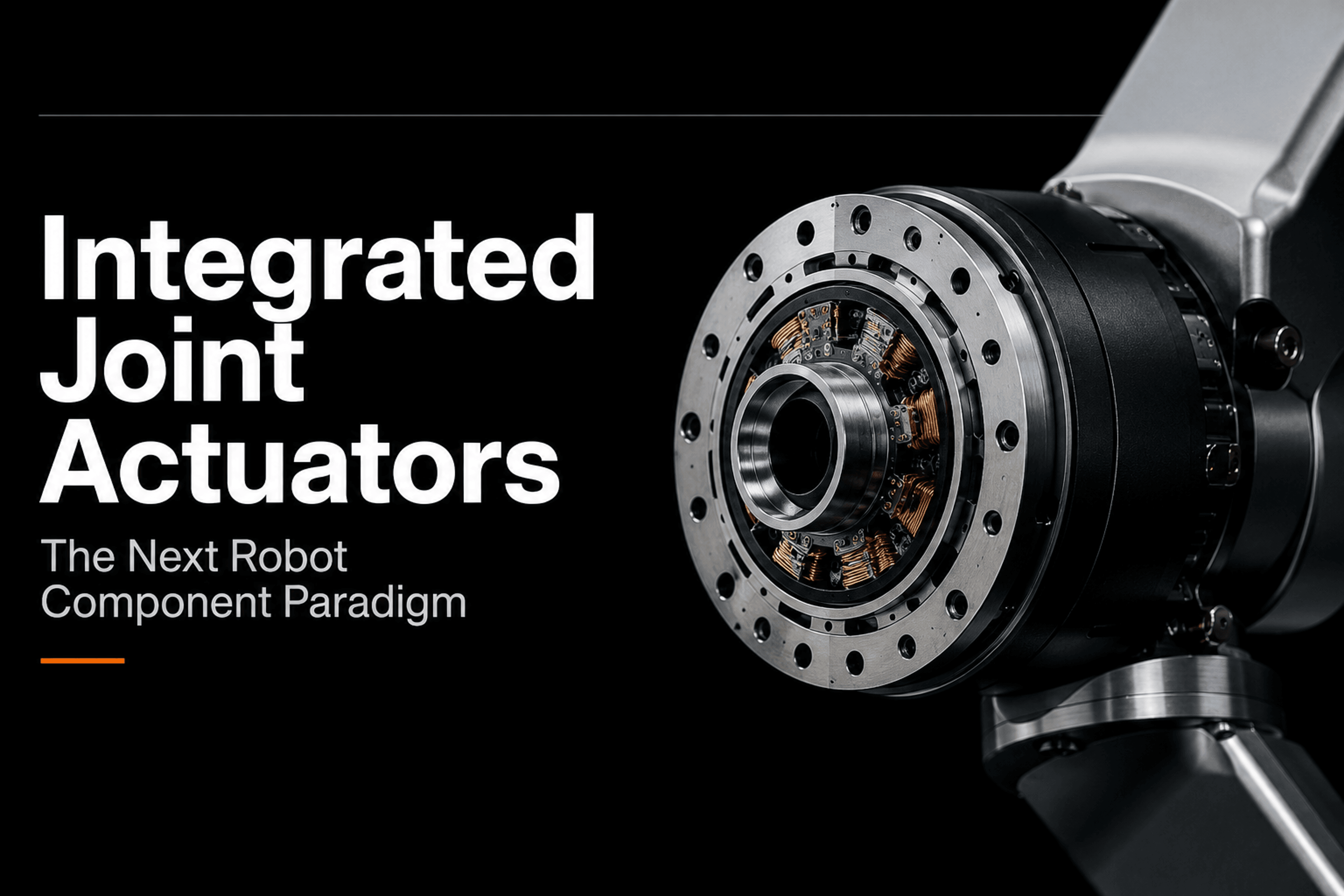
Integrated Joint Actuators 2026: Technology, Global Suppliers & China's Leap Forward

Integrated Joint Actuators 2026: Technology, Global Suppliers & China's Leap Forward

From rotary joints hitting 530 N·m+ to linear joints with planetary roller screws, integrated actuators are replacing the three-part drivetrain. Full supplier map: Tihu, PhyArc, RobStride, Schaeffler, maxon — and China's path from 1,000-RMB modules to global standard-setter.