

Robotics has become one of the most strategically consequential disciplines of the 21st century. A small number of universities have consistently defined its frontier — not merely through publications, but through their ability to deploy systems in real-world environments, seed commercial enterprises, and produce the engineers who go on to lead the industry. Here is where they stand.
1. Carnegie Mellon University (CMU) Robotics Institute
CMU's claim to the top position is grounded in institutional history that no other university can replicate. In 1979, CMU founded the world's first academic department devoted entirely to robotics — a structural commitment that has now compounded over nearly five decades. The founding premise, articulated from the outset by computer science and AI pioneer Raj Reddy, was that robotics research required more than mechanical engineering: it demanded the integration of perception, reasoning, and autonomous action into complete systems designed to function in the real world. That philosophy anticipated by decades the "embodied AI" paradigm that now drives the industry's most significant investment.
The Institute's early fieldwork set the tone. Red Whittaker and colleagues deployed the Remote Reconnaissance Vehicle following the 1979 Three Mile Island nuclear accident — one of the first instances of a robot operating in a genuinely hazardous, uncontrolled environment. CMU teams subsequently competed in DARPA's autonomous vehicle challenges, laying technical foundations that would later underpin the entire self-driving industry. Faculty such as Manuela Veloso meanwhile advanced human-robot interaction, exploring how robots could operate safely alongside people in hospitals and offices.
Translating research into deployable technology has been equally systematic. In 1994, Whittaker and colleague Dave Pahnos began discussions with NASA about commercializing CMU's robotics work, leading to the establishment of the National Robotics Engineering Center (NREC) with a $2.5 million NASA seed grant. NREC became a durable bridge between academic research and real-world application: technologies it developed now power autonomous systems in John Deere agricultural equipment and Caterpillar mining machinery operating in some of the world's most demanding environments.
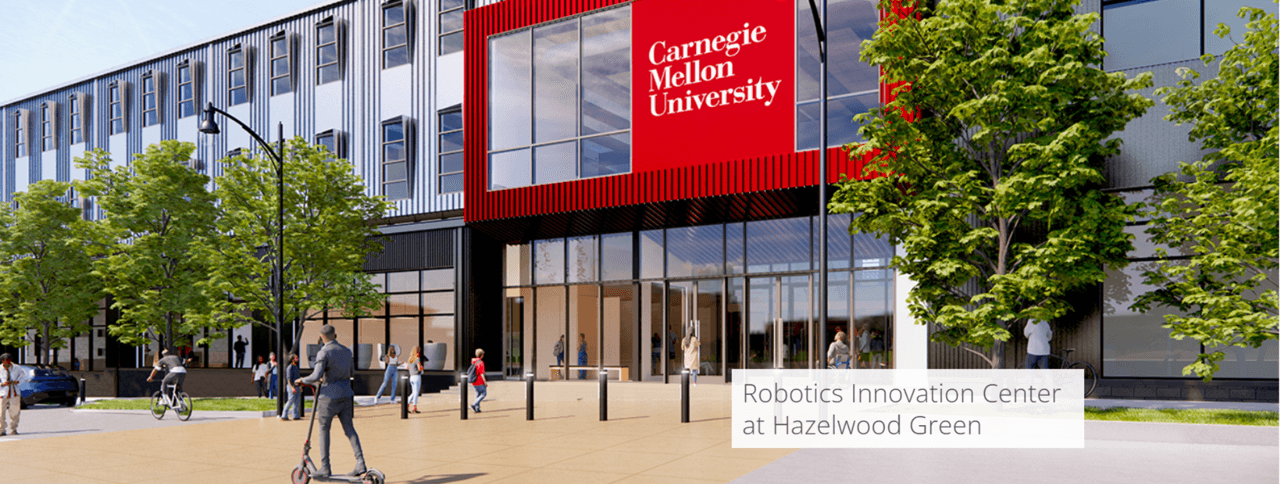
The latest chapter is the Robotics Innovation Center (RIC), a 150,000-square-foot facility that opened on February 27, 2026 at Pittsburgh's Hazelwood Green — a former steel mill site. The RIC provides purpose-built testing environments for land, air, water, and space robotics, co-location space for corporate partners, and integration with CMU's Manufacturing Futures Institute and AI Science Foundry. Its inaugural corporate tenant is FieldAI, a physical AI unicorn valued at $2 billion, which chose the RIC — in the words of the Pittsburgh Technology Council — not as a courtesy, but as a deliberate calculation based on the depth and quality of CMU's talent and research infrastructure.
As CMU Vice President for Research Theresa Mayer has stated, Carnegie Mellon didn't merely participate in the birth of robotics — it helped shape its intellectual DNA.
2. Robotics @ MIT
MIT's CSAIL remains one of the world's most productive robotics research environments. Its lineage runs directly through the founding of Boston Dynamics and continues to define the state of the art in humanoid locomotion, dexterous manipulation, and soft robotics. MIT's proximity to Boston's life sciences corridor gives it particular strength in medical and rehabilitation robotics.
3. Stanford Robotics Center
Stanford's location at the center of Silicon Valley creates an unusually tight feedback loop between academic research and venture-funded deployment. It leads globally in robot perception, computer vision, and deep learning-based control, with direct ties to the autonomous vehicle and consumer robotics industries.
4. UC Berkeley Mechanical Engineering
Berkeley's BAIR (Berkeley AI Research) Lab has become the primary academic incubator for robot learning — especially reinforcement learning applied to manipulation and generalist robot policies. Berkeley researchers have been central to open-source robotics tooling and large-scale data-driven approaches to robot training, making it arguably the most influential institution in the current wave of foundation model-driven robotics.
5. Center for Robotics | ETH Zurich
Europe's undisputed leader. ETH is the institutional origin of ANYbotics and its ANYmal quadruped, one of the most commercially significant legged robots in deployment. Its work in state estimation, agile locomotion, and field robotics sets the European benchmark and has produced some of the most-cited research in autonomous navigation.
6. Institute for Robotics and Intelligent Machines (IRIM)
Georgia Tech has developed a distinctive depth in human-robot interaction, collaborative manufacturing robotics, and rehabilitation and assistive systems. It is particularly relevant to aging-population applications and industrial co-robot deployment, with strong DARPA and NSF-funded research programs.
7. Michigan Robotics | University of Michigan
Michigan combines deep automotive industry ties with purpose-built infrastructure — including MCity, one of the world's most advanced autonomous vehicle testing environments. Its focus on self-driving systems and bipedal locomotion is reinforced by the proximity of the global auto industry.
8. Robotics and Autonomous Systems - TUM
Germany's leading technical university and the academic backbone of Industry 4.0. TUM has exceptional depth in industrial control, surgical robotics, and multi-modal sensing, backed by dense partnerships with German automotive and medical device manufacturers.
9. Oxford Robotics Institute - University of Oxford
Oxford's Robotics Institute leads in long-term robot autonomy for unstructured real-world environments — directly relevant to field robotics, logistics, and environmental monitoring. Its work on probabilistic navigation and semantic mapping has had significant downstream industry impact.
10. Robotics and Autonomous Systems Center - University of Southern California (USC)
USC has carved out recognized strengths in underwater robotics, multi-agent coordination, and computer vision, with active programs in defense-adjacent and maritime applications.
What Separates This Cohort
These ten institutions share three structural advantages: a multi-decade institutional commitment to robotics as a primary research domain; a demonstrated track record of commercial spinouts and technology transfer; and the physical and organizational infrastructure to take systems from prototype to deployment. CMU scores highest on all three. Its 47-year head start, combined with NREC's industry translation model and the newly opened RIC's scale, gives it a compounding advantage that rivals have not closed. The RIC's opening in February 2026 is the latest data point in a trajectory that began with a single founding premise in 1979: that robots must be built to work in the real world, not just the laboratory.







Leave a comment