


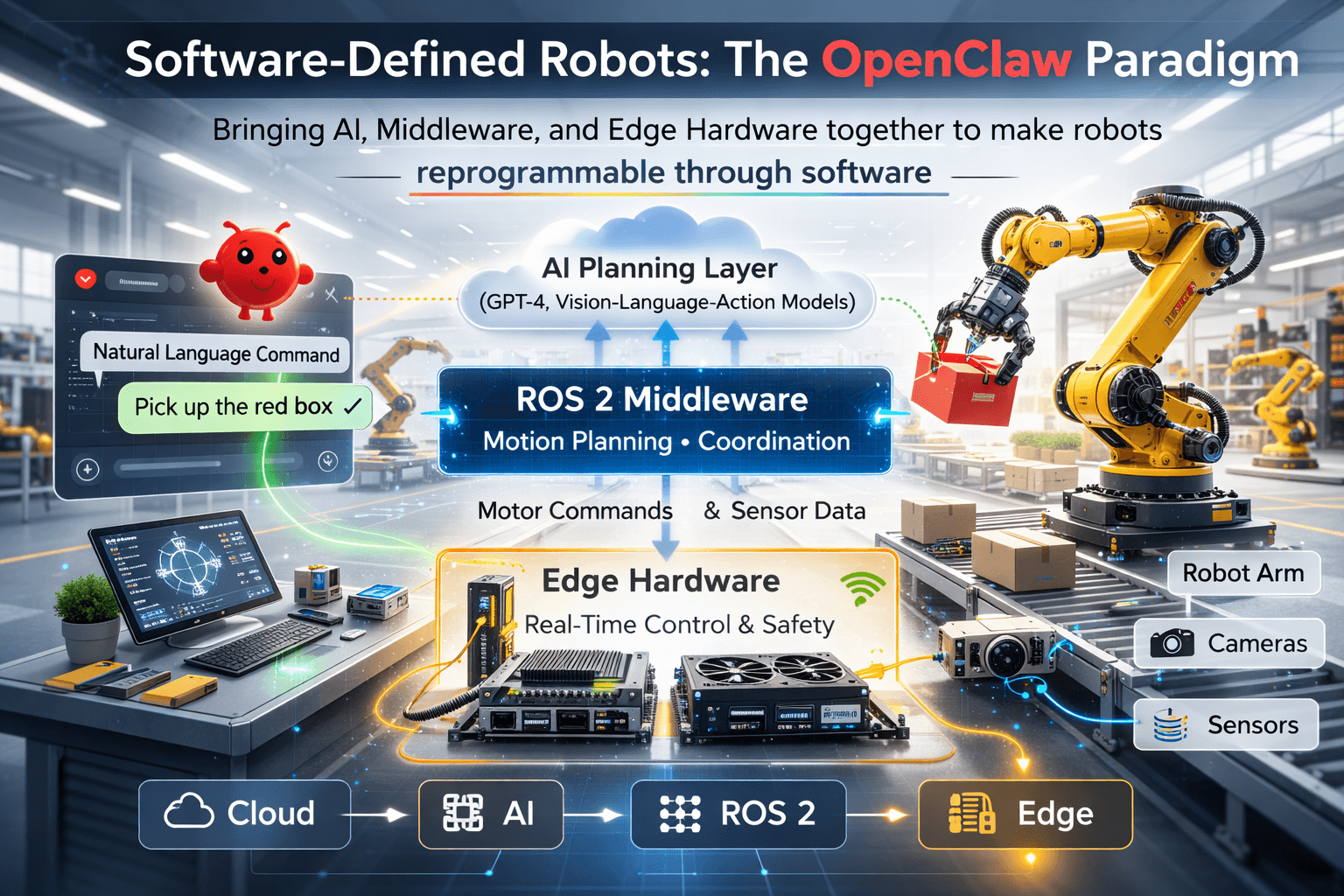
The next industrial revolution won't require retooling factories—just rewriting code.
When developer Peter Steinberger released OpenClaw in early 2025, he created something unexpected: a viral open-source AI agent that runs on commodity hardware (often a Mac Mini), communicates through WhatsApp or Telegram, and automates digital tasks like email management, coding, and web scraping. It's not a robot in the physical sense—it's pure software intelligence.
But OpenClaw represents something profound: a pattern for how intelligent agents can be deployed, customized, and controlled through simple interfaces. And this pattern is now bleeding into physical robotics, promising to transform how we build, deploy, and reprogram machines that actually move and manipulate the world.
The OpenClaw Pattern: Intelligence as Infrastructure
What makes OpenClaw significant isn't its specific capabilities—it's its architecture:
Accessible deployment on consumer hardware, natural interfaces via messaging apps, open extensibility through community development, and task abstraction where users describe intent rather than implementation steps.
This "conversational control + autonomous execution" model is now inspiring physical robotics. If an AI agent can manage email through WhatsApp commands, why couldn't a robot handle warehouse tasks through similar natural language instructions?
The OpenClaw Pattern: Intelligence as Infrastructure
What makes OpenClaw significant isn't its specific capabilities—it's its architecture:
Accessible deployment on consumer hardware, natural interfaces via messaging apps, open extensibility through community development, and task abstraction where users describe intent rather than implementation steps.
This "conversational control + autonomous execution" model is now inspiring physical robotics. If an AI agent can manage email through WhatsApp commands, why couldn't a robot handle warehouse tasks through similar natural language instructions?
From Digital to Physical: The Robot Operating System Layer
The bridge from OpenClaw-style digital agents to physical robots requires middleware that can translate high-level intentions into motor commands, sensor fusion, and real-time control. This is where ROS 2 (Robot Operating System) becomes critical.
ROS 2 provides the infrastructure layer that OpenClaw lacks for physical embodiment:
- Standardized hardware interfaces: Arms, grippers, mobile bases, sensors communicate through common protocols
- Real-time control loops: Millisecond-level coordination of actuators and feedback systems
- Motion planning: Translating "pick up that box" into specific joint trajectories and grasp poses
- Sensor fusion: Combining camera, lidar, force sensors into coherent world understanding
The emerging architecture looks like:
Natural Language Interface (OpenClaw-style) - Cloud
         ↓
AI Planning Layer (GPT-5, Claude, specialized models) - Cloud
         ↓
ROS 2 Middleware (motion planning, coordination) - Edge
         ↓
Hardware Layer (modular grippers, arms, bases) - Edge
         ↓
Edge AI Chips (real-time vision and control) - Edge
The cloud-edge split matters critically: High-level reasoning ("what should I do today?") can happen in the cloud with powerful models and tolerate 100-500ms latency. But safety-critical control loops—collision avoidance, force limiting, emergency stops—must run on-device at <10ms response times. This hybrid architecture mirrors how Tesla's Autopilot works: cloud for planning and learning, edge for real-time driving decisions. In production robotics, you cannot rely on network connectivity for safety—the edge must be autonomous.
Companies like Physical Intelligence (π₀) and Covariant are building exactly this: foundation models that can understand "pick up the red object" and translate it through ROS-like middleware into actual robot motions—all configurable through natural language rather than code.
The Perfect Storm: Why Now?
Three converging trends enable this OpenClaw-to-robotics transition:
First, AI models have generalized beyond digital tasks. Vision-language-action (VLA) models can now understand physical scenes, reason about object properties, and generate manipulation plans. What OpenClaw does for email, these models do for "pick up that irregularly-shaped object."
Second, edge AI hardware can run sophisticated models locally. NVIDIA's Jetson modules and specialized chips provide enough compute to run perception and control models on robots themselves, with carefully optimized models handling real-time decisions. The economics have shifted: a $300-600 edge AI setup can now handle tasks requiring local visual reasoning and motor control.
Third, open middleware (ROS 2) has matured enough to provide standardized interfaces between AI planning layers and physical hardware. While it still faces challenges in safety-critical industries and deterministic real-time control, it's production-ready for warehousing, light manufacturing, and service robotics.
The critical tension: OpenClaw-style AI reasoning is inherently probabilistic—it might interpret "pick up that object" differently each time based on context. ROS 2 and industrial control systems strive for deterministic behavior—the same input should always produce the same output. The magic and the danger happen at this interface: AI suggests what to do (probabilistic), safety systems verify it's permissible (deterministic), then execute. This requires sophisticated "guard rails" that constrain AI creativity within safe operational envelopes.
The Paradigm Shift: Traditional vs. Software-Defined
The OpenClaw pattern represents a fundamental architectural change:
| Feature | Traditional Robotics | The OpenClaw Paradigm |
|---|---|---|
| Interface | C++/Proprietary teach pendant | WhatsApp/Natural language |
| Learning | Hard-coded logic | Vision-language-action models |
| Deployment | Months of integration | "Zero-shot" or few-shot training |
| Hardware | Custom/Proprietary | Modular/Standardized (via ROS 2) |
| Updates | On-site reprogramming | OTA software updates |
| Skill Transfer | Non-existent | Behaviors shareable across fleets |
This isn't just incremental improvement—it's a category change in how robots are conceived, deployed, and maintained. The cost and time barriers that kept robotics limited to large enterprises with dedicated integration teams are eroding.
Lower deployment barriers: Warehouse operators could describe tasks in natural language rather than hiring integration specialists. The robot "figures it out" through foundation models, like OpenClaw interpreting "summarize my emails from this week."
Faster adaptation: Software updates reconfigure robot behaviors within hardware limits. A packaging robot trained on boxes can adapt to bottles through additional examples and model updates.
Ecosystem effects: Just as OpenClaw spawned open-source extensions, software-defined robots will create marketplaces for validated behaviors—though requiring enterprise-grade safety validation, not consumer app-store simplicity.
The Hardware Reality Check
The OpenClaw pattern works brilliantly for digital tasks because bits are infinitely flexible. Physical robots face harder constraints:
A robot optimized for ±1cm warehouse sorting cannot become a surgical assistant (±0.1mm precision) through software alone—the mechanical tolerances, actuator resolution, and sensor precision are fundamentally different. Software-defined doesn't mean hardware-independent.
The realistic opportunity: robots that can flexibly adapt within their morphological constraints. A collaborative arm with adequate precision could switch between light assembly, quality inspection, and material handling through software—tasks that share similar physical requirements. This is valuable even if not unlimited.
The Robotics Stack: Complementary Layers
The robotics landscape is defined by three distinct layers, each serving critical but different roles:
ROS 2 serves as the universal middleware for research and mobile robotics, offering hardware-agnostic flexibility that allows components from different manufacturers to work together. It's the "connective tissue" enabling modular robotics systems. However, it's still maturing in real-time safety certification—limiting its use in regulated industries where deterministic behavior must be legally certified.
NVIDIA Isaac complements this by providing high-performance AI and simulation pipelines, essentially acting as a GPU-accelerated "turbocharger" for the ROS 2 ecosystem. Its strength lies in perception (visual understanding) and digital twins (virtual testing environments), enabling developers to train and validate robot behaviors in simulation before physical deployment. The tradeoff: tight coupling to NVIDIA hardware.
Proprietary industrial stacks (KUKA, ABB, Fanuc) maintain their stronghold in high-precision manufacturing by delivering hardened, safety-certified real-time control that open-source alternatives have yet to match. These systems prioritize precision and reliability over flexibility, designed for applications where millimeter-level accuracy and legal compliance are non-negotiable.
| Layer | Primary Role | Hardware Scope | Key Strength | Current Limitation |
|---|---|---|---|---|
| ROS 2 | Middleware & Connectivity | Agnostic (CPU/GPU/MCU) | Ecosystem & Flexibility | Safety certification gaps |
| NVIDIA Isaac | AI & Simulation Acceleration | NVIDIA-Specific (Jetson/RTX) | Perception & Digital Twins | Hardware dependency |
| Industrial Stacks | Hardened Execution & Safety | Proprietary Hardware | Precision & Reliability | Closed systems, limited flexibility |
The future isn't winner-take-all but functional stratification: ROS 2 providing the open integration layer, NVIDIA Isaac accelerating AI workloads, and industrial stacks handling safety-critical precision. The winning approach combines these layers—open middleware for adaptability, specialized accelerators for AI performance, and certified control for safety-critical operations.
The Challenges Ahead
Safety and certification: Traditional frameworks assume deterministic behavior. AI systems are probabilistic—behavior in novel situations cannot be fully predicted. The EU's AI Act classifies "physical support AI" as high-risk.
Liability: When an OpenClaw agent misfiles email, consequences are minor. When a robot injures someone, liability chains become complex across model providers, middleware developers, hardware manufacturers, and deployers.
Economic disruption: More accessible robots accelerate automation of manual labor across warehousing, food service, and manufacturing. Platform economics will likely concentrate control despite democratizing access.
Verification: How do you certify a robot whose behavior emerges from billions of neural network parameters? Traditional validation assumes enumerable states—foundation models make this impossible.
The Pragmatic Vision
OpenClaw's viral success shows demand for AI agents with conversational interfaces, autonomous execution, and ordinary hardware deployment. Translating this to physical robotics faces harder constraints, but the direction is clear.
We're heading toward stratified adaptability: robots that flexibly reconfigure within their morphological niche through software and natural language tasking, deployed through OpenClaw-style interfaces rather than requiring robotics expertise.
The revolution isn't infinite programmability—it's sufficient programmability to change automation economics, making flexible manufacturing and adaptive logistics viable for mid-sized operators previously unable to afford custom integration.
Software ate the digital world. Patterns pioneered by tools like OpenClaw now show how software can reshape the physical world—gradually, within constraints, but inexorably.





Leave a comment