


EXECUTIVE SUMMARY
Overview
The global laboratory robotics market sits at approximately USD 8.5 billion in 2025, on a trajectory toward USD 18 billion by 2030 at a consensus CAGR of 7–9.4%. Across twelve distinct vertical sectors, however, the picture is highly differentiated: two verticals — clinical diagnostics and pharmaceutical high-throughput screening — are already at industrial mass-production scale, while others such as autonomous closed-loop discovery and environmental monitoring remain on a 2030+ horizon.
This analysis maps the technology readiness of six core pillars, profiles 26 companies across the global value chain, and provides sector-by-sector verdicts on when each vertical will reach mass-production maturity.
1. MARKET OVERVIEW
Market size and growth
The laboratory automation market recorded a 2024 baseline of approximately USD 5.97–8.27 billion depending on scope definition — hardware-only versus integrated software and services. Projections for 2025 cluster at USD 6.4–9.2 billion. The pharmaceutical and biotechnology sector held the largest end-user share at 40.4% in 2025. Clinical and diagnostic laboratories represent the fastest-growing end-user segment, expected to expand at 8.1% CAGR through 2035.
Software is outpacing hardware on growth rate: cloud/SaaS-based deployment is growing at 8.2% CAGR, and the software layer overall at 8.4%, reflecting the structural shift from hardware procurement to platform subscription models. North America commands 37–48% of global market share; Asia-Pacific — led by China — is the fastest-growing region, driven by government R&D mandates and domestic hardware manufacturing scale.
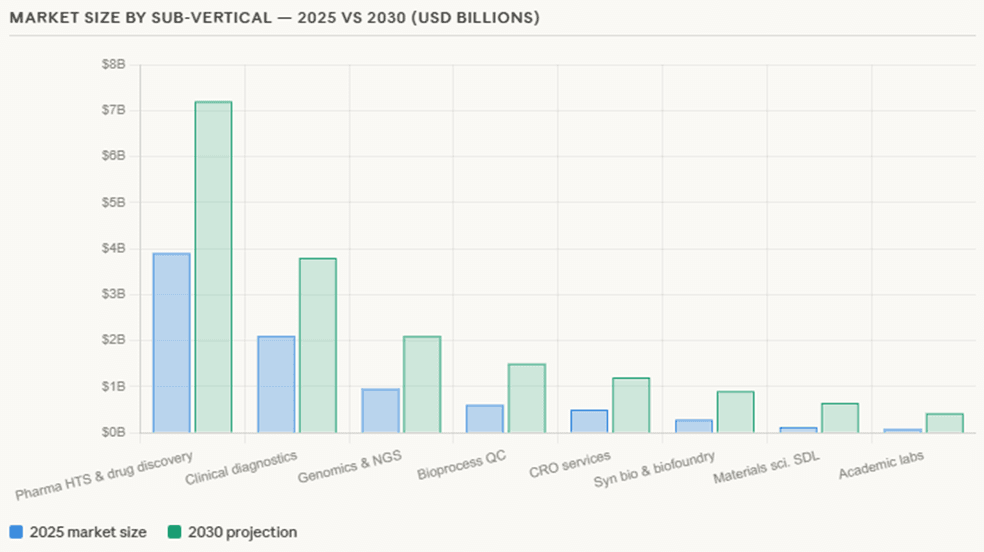
Table 1: Market size by sub-vertical — 2025 vs 2030
| Sub-vertical | 2025 est. | 2030 proj. | CAGR | Growth driver |
| Pharma HTS & drug discovery | $3.9B | $7.2B | ~13% | Largest sub-segment; AI-driven screening expansion |
| Clinical diagnostics | $2.1B | $3.8B | ~13% | TLA adoption; IVD automation driving high volumes |
| Genomics & NGS sample prep | $0.95B | $2.1B | ~17% | Single-cell & spatial genomics creating step-change demand |
| Bioprocess QC / biopharma mfg | $0.60B | $1.5B | ~20% | Cell & gene therapy GMP compliance catalyst |
| CRO services | $0.50B | $1.2B | ~19% | Platform-model CROs capturing outsourced automation |
| Synthetic bio / biofoundries | $0.28B | $0.9B | ~26% | Fastest growing — policy + corporate capital tailwind |
| Materials science / chemistry SDL | $0.12B | $0.65B | ~40% | High-growth from low base; Chemifarm model expanding |
| Academic labs | $0.08B | $0.42B | ~39% | Democratisation through open platforms and cloud access |
Source: MarketsandMarkets, Precedence Research, Meditech Insights, RobotToday estimates. April 2026.
2. TECHNOLOGY PILLARS
Six core technology pillars — TRL and market readiness
Laboratory robotics is not a monolithic technology but a stack of distinct layers, each at a different technology readiness level (TRL). The following table maps the six pillars against their current TRL, leading players, primary verticals, and mass-production readiness verdict.
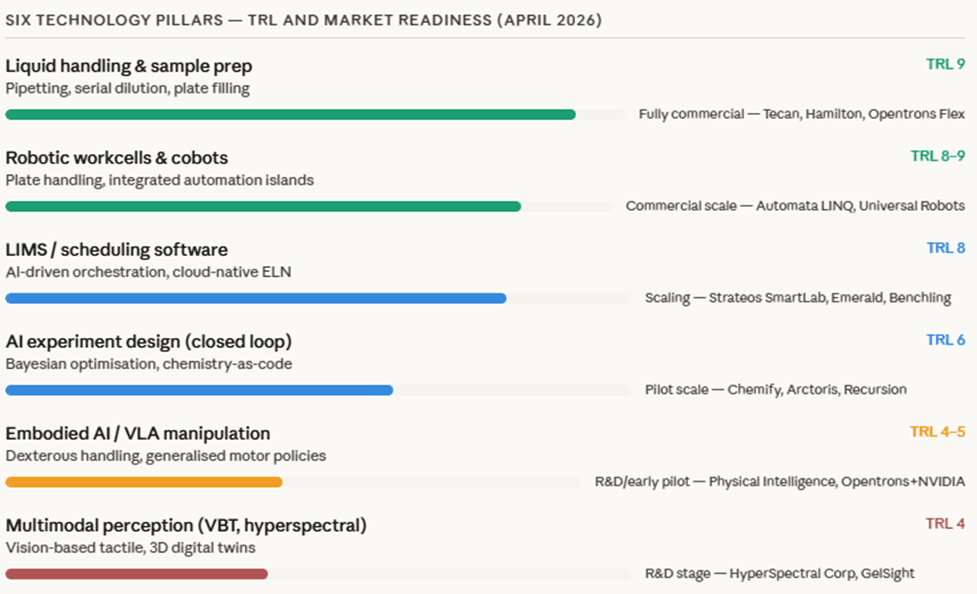
Table 2: Technology pillars — maturity and readiness
| Technology pillar | Maturity (TRL) | Leading players | Primary verticals | Mass-prod. readiness |
| Liquid handling & sample prep | TRL 9 — Fully commercial | Tecan Fluent, Hamilton STAR, Opentrons Flex | Pharma HTS, clinical, genomics | NOW |
| Robotic workcells & cobots | TRL 8–9 — Commercial scale | Automata LINQ, Universal Robots, HighRes | Drug discovery, bioprocess, HTS | NOW |
| LIMS / scheduling software | TRL 8 — Scaling | Strateos SmartLab, Emerald, Benchling, Biosero | All verticals | 2025–2026 |
| AI experiment design (closed loop) | TRL 6 — Pilot scale | Chemify, Arctoris, Recursion, Insilico | Drug discovery, materials sci. | 2027–2028 |
| Embodied AI / VLA manipulation | TRL 4–5 — Early pilot | Physical Intelligence, Opentrons+NVIDIA Isaac/Cosmos | Generalised lab tasks | 2028–2030 |
| Multimodal perception (VBT, hyperspectral) | TRL 4 — R&D stage | GelSight, HyperSpectral Corp, Xela Robotics | Dexterous handling, QC | 2029–2031 |
TRL scale: 1 (basic research) to 9 (fully operational at commercial scale). Assessments by RobotToday, April 2026.
The Physical AI inflection point — 2026
The single most structurally significant development between 2025 and 2026 is the crossing of the threshold from scripted robotics — fixed protocols, deterministic movements — to adaptive physical AI, specifically vision-language-action (VLA) models trained on real-world manipulation data. Opentrons' integration of NVIDIA Isaac and NVIDIA Cosmos physical AI software across its global network of 10,000 laboratory robots (February 2026) is the clearest indicator that physical AI is entering the lab hardware stack at commercial scale.
Liquid handling (TRL 9) and workcell orchestration (TRL 8–9) are effectively commoditised. The value creation frontier has migrated entirely to the software and AI layers: intelligent scheduling, autonomous experiment design, and closed-loop feedback systems. Companies competing on hardware alone face margin compression; the defensible position is the AI orchestration platform.
3. VERTICAL SECTOR MATURITY
When does each sector reach mass-production scale?
Mass production is defined here as: standardised, repeatable deployment with more than 50 commercial installations globally in the sector, with established supply chains, regulatory acceptance, and a competitive vendor market. The following table provides a verdict for each of 12 vertical sectors.
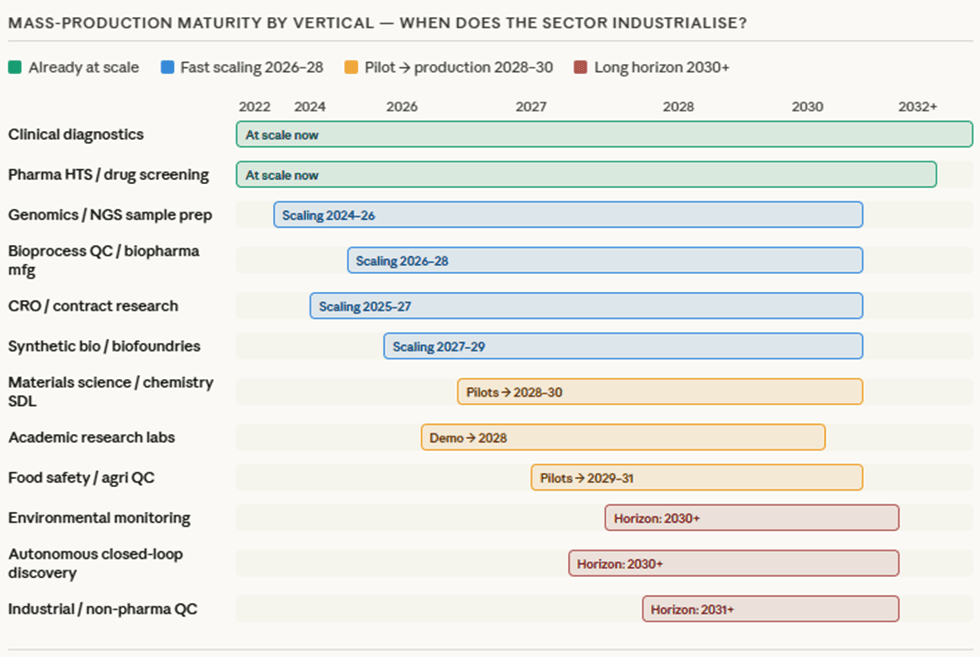
Table 3: Vertical sector maturity and mass-production timeline
| Vertical sector | Status (Apr 2026) | Key players | Key use cases | Mass-prod. verdict |
| Clinical diagnostics & hospital labs | At scale NOW | Siemens, Roche, BD, Beckman Coulter | Mass deployment of automated analysers, total lab automation (TLA) | Mass production — mature |
| Pharmaceutical HTS & drug screening | At scale NOW | Tecan, Hamilton, HighRes, Biosero | Compound screening, assay development, lead optimisation at robot scale | Mass production — mature |
| Genomics / NGS sample preparation | Scaling 2024–2026 | Opentrons, SPT Labtech, BD + Opentrons (Oct 2025) | Library prep, single-cell multiomics, liquid biopsy workflows | Commercialising now |
| Bioprocess QC / biomanufacturing | Scaling 2026–2028 | Meihua Robotics, Thermo Fisher, Tecan, Multiply Labs | GMP-compliant QC automation, cell & gene therapy scale-up | 2026–2028 inflection |
| CRO / contract research services | Scaling 2025–2027 | Arctoris, Strateos, Emerald Cloud Lab | Platform-level automation embedded in CRO service delivery | Commercial scaling now |
| Synthetic biology / biofoundries | Scaling 2027–2029 | Ginkgo Bioworks, LabGenius, Benchling + partners | Closed-loop design-build-test-learn; government-backed biofoundries | 2027–2028 inflection |
| Materials science / chemistry SDL | Pilots → 2028–2030 | Chemify (Chemifarm), Zeon, b12 Labs | Chemistry-as-code, autonomous synthesis, reaction optimisation loops | 2028 target |
| Academic research labs | Demo → 2027–2028 | Opentrons, Emerald (ECL), CMU cloud lab | Open/affordable platforms; NSF-funded cloud lab networks | 2027–2028 adoption wave |
| Food safety / agricultural QC | Pilots → 2029–2031 | Agilent, Anton Paar, bespoke integrators | Rapid contaminant screening, pesticide residue, allergen panels | 2029–2031 horizon |
| Environmental monitoring networks | Horizon: 2030+ | Early research; no dominant commercial player | Autonomous field and lab sampling; regulatory frameworks immature | Long horizon 2030+ |
| Autonomous closed-loop discovery | Horizon: 2028–2030 | Chemify, Physical Intelligence, 星海图 | Full hypothesis → synthesis → test → iterate without human checkpoints | 2028–2030 pilot → scale |
| Industrial / non-pharma QC | Horizon: 2031+ | Bespoke system integrators | Process analytical technology (PAT) outside regulated pharma | Long horizon 2031+ |
RobotToday assessment based on installed base data, regulatory environment, and vendor interviews. April 2026.
Three investment and editorial theses
The twelve verticals can be consolidated into three distinct commercial theses:
Already won (clinical diagnostics, pharma HTS): Massive installed base dominated by listed incumbents. The editorial story is margin compression, consolidation M&A, and software up-sell — not breakthrough innovation.
Scaling now (genomics, CRO services, bioprocess QC): The 2026–2028 commercial inflection point. Opentrons, Automata, Arctoris, and Benchling are the names to watch. This is where mid-market capital is actively flowing.
The next wave (self-driving labs, physical AI manipulation, materials science): The 'ChatGPT moment' for physical AI in laboratories is a 2028–2030 event. Chemify, Physical Intelligence, and China's embodied AI cohort are positioning now for a 5–10 year horizon.
4. COMPANY LANDSCAPE
26 key players across the global value chain
The competitive landscape spans two structurally different arenas. International players (US/UK/EU) lead on software depth, cloud orchestration, and AI model quality — exemplified by Strateos' SmartLab platform, Chemify's Chemifarm synthesis network, and Emerald Cloud Lab's full-service model. Chinese players lead on hardware cost, manufacturing velocity, and government-backed scale — shipping over 50% of global industrial robots and migrating that capability aggressively into lab-specific cobots and embodied AI systems.
Consolidation is accelerating: Tecan's acquisition of Wako Automation's Director scheduling software (December 2025) illustrates the pattern — incumbent hardware players acquiring scheduling and AI software capability to defend margin and lock in platform relationships.
Table 4: Company landscape — 26 key players
| Company | HQ | Core focus | Stage | Funding | Primary vertical |
| Tecan Group | CH | Liquid handling, lab workflow integration | Public | CHF 600M+ rev | Pharma, clinical, genomics |
| Thermo Fisher Scientific | US | Full lab automation portfolio, instruments | Public | $~45B revenue | All verticals |
| Hamilton Company | US | Precision robotic pipetting, sample prep | Private | Undisclosed | Clinical, pharma HTS |
| Opentrons | US | Open liquid handling, AI-enabled robots | Series C | $261M raised | Genomics, academic, CRO |
| Automata | UK | Modular LINQ platform, low-code automation | Series C | Jan 2026 round | Drug discovery, cell biology |
| Chemify | UK | Chemistry-as-code, Chemifarm synthesis network | Series B | $50M+ | Chemical synthesis, materials |
| Strateos | US | SmartLab cloud platform, on-premises automation | Private | ~$90M total | Drug discovery, synthetic biology |
| Emerald Cloud Lab | US | Full-service remote lab-as-a-service | Private | Undisclosed | Academic, biotech, CRO |
| Arctoris | UK | AI-driven remote drug discovery CRO | Series B | Undisclosed | Drug discovery, CRO |
| Recursion Pharmaceuticals | US | AI + HTS integrated discovery platform | Public | $1B+ raised | Pharma, drug discovery |
| Agilent Technologies | US | Lab instruments, genomics, diagnostics | Public | $~7B revenue | Genomics, pharma, food |
| Siemens Healthineers | DE | Clinical lab automation, diagnostics | Public | €22B+ revenue | Clinical diagnostics |
| Becton Dickinson (BD) | US | Microbiology, single-cell, flow cytometry | Public | $~20B revenue | Clinical, genomics |
| Biosero / Green Button Go | US | Lab scheduling, integration software | Private | PE-backed | Pharma HTS, CRO |
| Multiply Labs | US | Personalised medicine manufacturing | Series B | Undisclosed | Pharma mfg, cell therapy |
| Insilico Medicine | HK | AI drug design + automated synthesis | Pre-IPO | ~$400M raised | Drug discovery (AI-first) |
| Benchling | US | ELN, LIMS, biotech R&D OS | Series F | ~$250M raised | Biotech, pharma, CRO |
| Megarobo | CN | Lab cobots, life science automation | Late-stage | CN VC-backed | Pharma, clinical (China) |
| Benyao | CN | Full-stack lab automation, protein engineering | Series B+ | CN VC-backed | Biotech, syn bio (China) |
| Ginkgo Bioworks | US | Biofoundry platform, cell programming | Public | $800M+ raised | Synthetic biology |
| HighRes Biosolutions | US | HTS automation, Cellario orchestration SW | Private | PE-backed | Pharma HTS, academic |
| SPT Labtech | UK | Acoustic dispensing, micro-volume handling | Private | PE-backed | Genomics, HTS, single-cell |
| Revvity (ex-PerkinElmer) | US | Diagnostics, imaging, lab automation | Public | $~3B revenue | Clinical, pharma |
| Physical Intelligence (π) | US | General-purpose VLA robot policies | Series B | $400M raised | Lab manipulation (2028+) |
| LabGenius (UK) | UK | ML-guided protein engineering platform | Series B | $37M | Biotech, pharma R&D |
| Galaxea AI | CN | World-model physical AI for lab robots | Series A | CN VC | Embodied AI labs (2028+) |
Funding and valuation data from public sources, Tracxn, Crunchbase, and company announcements. April 2026.
5. INVESTMENT CLIMATE
2025 robotics VC: USD 14 billion globally
Global robotics venture capital reached USD 13.9–14 billion in 2025, up 70% year-over-year. Q1 2026 alone saw over USD 2.26 billion in robotics funding, with more than 70% going to firms focused on warehouse and industrial automation. Laboratory and life science automation attracted approximately USD 1.8 billion — the third-largest category — with notable late-stage rounds including Automata's January 2026 Series C and Chemify's USD 50M+ round.
AI is now table stakes. Investors are seeking integrated platforms combining strong software IP with proprietary datasets. RaaS (Robotics-as-a-Service) business models are gaining traction for their recurring revenue and faster paths to profitability. Late-stage companies with deployed physical infrastructure — Chemifarm facilities, black-lab installations — command premium valuations over pure software players.
Table 5: 2025 robotics VC flow by category
| Category | 2025 VC est. | Share | Notable deals / notes |
| Industrial & warehouse robotics | $5.2B | ~37% | ABB/SoftBank deal, Amazon, Figure AI mega-rounds |
| Embodied AI & humanoid robotics | $3.1B | ~22% | Figure AI ($675M), Physical Intelligence ($400M), 1X ($100M+) |
| Healthcare & surgical robotics | $2.1B | ~15% | Intuitive Surgical, Mako, next-gen surgical platforms |
| Lab & life science automation | $1.8B | ~13% | Automata Series C, Chemify $50M+, Opentrons $261M total |
| Agricultural robotics | $0.9B | ~6% | Vertical farming robots, harvest automation |
| Construction robotics | $0.8B | ~6% | Gravis ($23M), BotBuilt, Machina Labs |
Estimates based on Crunchbase, Marion Street Capital, Standard Bots, and RobotToday analysis. April 2026.
6. RISKS & STRUCTURAL CHALLENGES
Key headwinds across the sector
High capex and integration complexity: Full lab automation installations require substantial capital and multi-vendor integration expertise, limiting adoption among SMEs and academic institutions.
Talent and skills gap: The intersection of AI/ML engineering and wet-lab biology expertise remains acutely scarce globally, throttling deployment velocity regardless of hardware availability.
Regulatory friction: GMP compliance, 21 CFR Part 11, and data integrity standards slow cloud and autonomous lab adoption in regulated pharmaceutical environments. Validation cycles add 12–24 months to deployment timelines.
Reproducibility risk: Fully AI-driven experimental science introduces new challenges for peer review, regulatory submission, and research reproducibility — frameworks for which do not yet exist.
Cloud lab economics: Remote-access cloud labs face structural cost challenges at academic scale. Emerald Cloud Lab access can exceed USD 250,000 per year — incompatible with standard grant budgets, limiting the democratisation thesis.
Geopolitical supply chain: US–China tensions create uncertainty around hardware component sourcing, export controls on AI chips, and cross-border technology licensing — particularly relevant for Chinese lab robot
7. OUTLOOK TO 2030
The road to the 'ChatGPT moment' for physical lab AI
Laboratory automation is on track to double in value by the early 2030s, becoming table-stakes infrastructure for competitive drug discovery and materials science. The structural shift — from scripted, instrument-specific automation to generalised physical AI capable of executing novel experimental workflows — is the defining event of the decade for the sector.
The 2026 pilots of VLA-based lab robots represent the equivalent of the 2021–2022 period in large language models: the technology works in controlled settings, but the tooling, training data, and regulatory frameworks for production deployment are 18–36 months away from maturity.
Winners in the 2030 landscape will combine: (1) modular hardware with cloud orchestration and open integration standards; (2) chemistry or biology-specific foundation models trained on proprietary high-quality experimental datasets; and (3) global 'as-a-service' facility networks on the Chemifarm or Strateos SmartLab model, delivering economic access without capital barriers.
China will be a formidable competitor in the physical hardware and cobot layer. The battleground for Western players is the AI model and orchestration software layer — where data moats, regulatory expertise, and pharma partnerships create defensible positions that manufacturing speed alone cannot replicate.









Leave a comment