


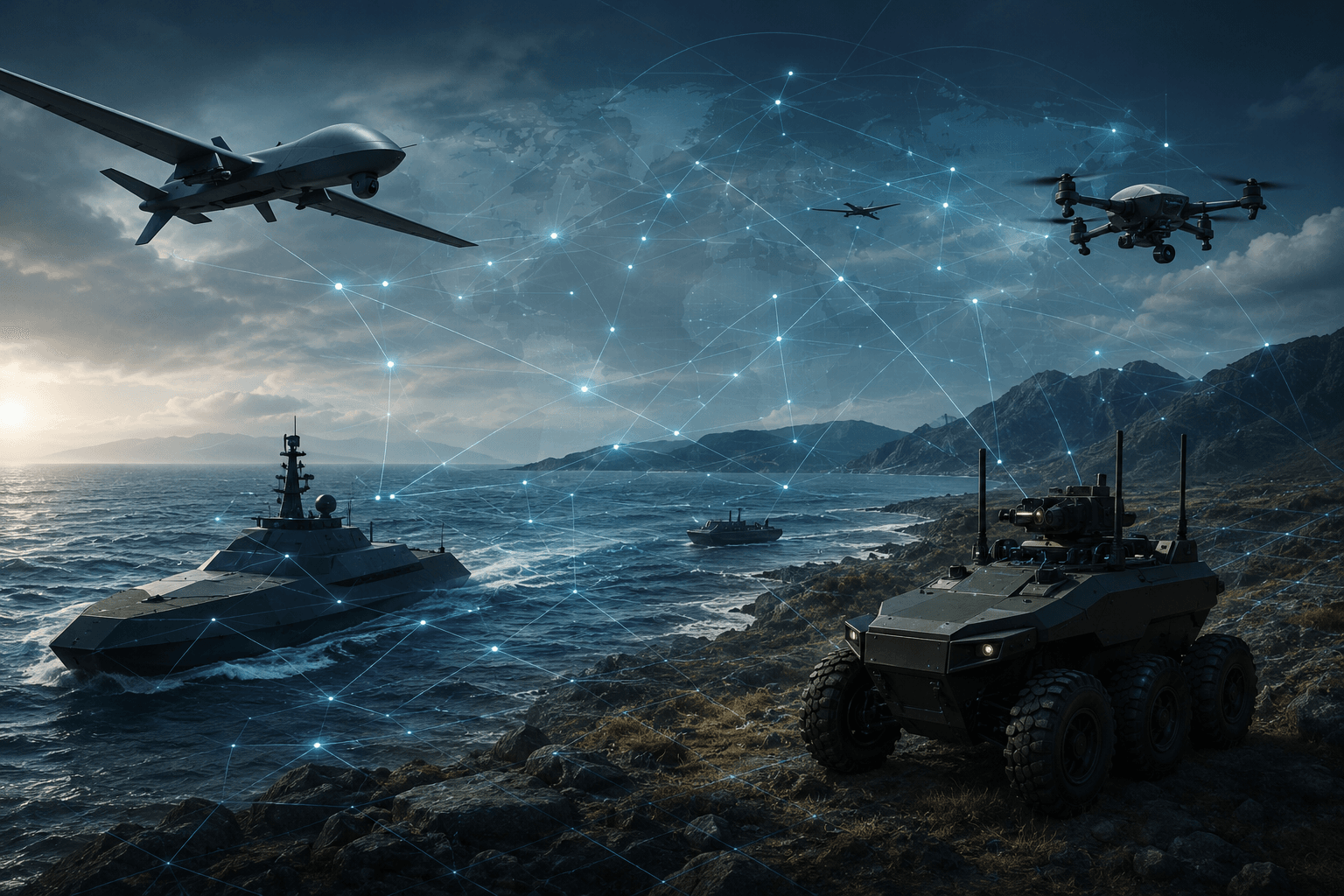
Introduction: The Kill Chain Is the Weapon
In the winter of 2024–25, a Ukrainian staff officer speaking under Chatham House rules at a defence conference described an operation that had taken place near the village of Lyptsi, north of Kharkiv, in December 2024. The assault featured ‘dozens’ of unmanned systems: UGVs equipped with machine guns and munitions, FPV drones supporting from the air, no crewed platforms, no boots on the ground. ‘The enemy was completely caught off guard,’ a Ukrainian military source told reporters. The operation — later described by defence analysts as a ‘seminal moment in the changing character of conflict’ — proved that multiple autonomous platforms from different domains could be coordinated in a single tactical action without a soldier physically present.
The lesson was not that the platforms themselves were revolutionary — the individual UGVs and FPVs involved had both been deployed separately for months. The lesson was the integration. When a UGV conducting mine clearance, a kamikaze UGV pressing the objective, and an FPV drone providing overwatch are coordinated as a single unit, their combined effect exceeds the sum of their parts. The enemy cannot respond to all three simultaneously. The kill chain becomes the weapon.
This article maps where that integration stands as of March 2026: in Ukraine’s combat-tested system-of-systems; in the U.S. Army’s Project Convergence experiments connecting USVs in Hawaii to UGVs in Arizona; in Palantir’s Maven Smart System compressing AI-assisted targeting timelines from hours to seconds across five combatant commands; and in the emerging concept of the UGV as a ground-based mothership for FPV drones — a tactical innovation that surfaced publicly just days before this article’s publication. The platforms covered in Parts 3A, 3B, and 3C of this series are individually powerful. Connected, they are transformative.
Sources: Breaking Defense, January 2025; CSIS, March 2025; Lieber Institute West Point, February 2025
Dec 2024 First all-domain all-drone assault, Lyptsi (Ukraine) | 5,000 mi Distance from which USV was controlled at PC-C5, April 2025 | $1.3B Palantir Maven Smart System contract ceiling (DoD, 2025) | 30 days NATO MSS deployment target after contract signing (March 2025) | Seconds Sensor-to-shooter timeline: Maven-assisted targeting, 2026 |
I. Ukraine’s Cross-Domain Laboratory: From Lyptsi to the Gnome-NS
Ukraine has become the world’s foremost live testbed for cross-domain autonomous integration, not because it planned to, but because survival required it. The Lyptsi operation of December 2024 was a doctrinal inflection point, but it did not emerge from nowhere. It was the culmination of a year-long evolution in which Ukrainian forces progressively integrated their drone and UGV capabilities into tighter, more coordinated loops.
The Lyptsi Operation: Architecture of an All-Drone Assault
Soldiers from Ukraine’s 13th Khartiia Brigade of the National Guard used the Ratel S UGV — a 4x4 platform developed through the Brave1 Defence Innovation Forum — as one of the primary ground elements. The operation covered the full spectrum of UGV mission sets: surveillance, mine clearance, and direct fire. FPV drones provided aerial observation and attack support. The integration was manual in the sense that human operators were controlling each platform remotely, but it was genuinely cross-domain: ground and air systems coordinating in real time on a single objective, with no physical human presence at the point of action.
CSIS’s March 2025 analysis of Ukrainian autonomous warfare described the broader doctrinal architecture: a ‘single kill chain’ merging reconnaissance UAVs, strike UAVs, and artillery in a unified command system. Reconnaissance drones identify and track targets; smaller strike UAVs execute precise attacks that exhaust defences; and those degraded defences then expose larger, higher-value targets to decisive artillery. The UGVs play multiple roles within this architecture — delivering fire where an aerial drone cannot penetrate, absorbing electronic warfare attention to free RF spectrum for aerial platforms, and providing persistent ground presence that a drone cannot.
The EW Problem and the Fibre-Optic Response
The single greatest constraint on cross-domain autonomous integration in Ukraine is electronic warfare. Both sides deploy broadband jamming that disrupts radio-frequency control links, forces operators to constantly shift frequencies, and has destroyed thousands of drones mid-mission. The Ukrainian response has been progressive hardening: encrypted multiband control links, AI-assisted autonomous last-mile guidance for FPVs operating in GPS-denied environments, and — most significantly — fibre-optic control cables for both FPV drones and UGVs.
Fibre-optic FPVs, first used by Russia in late 2024, reached mass-level fielding in Ukraine by summer 2025. A strand of glass fibre thinner than a human hair unspools behind the drone in flight; since the control signal travels as light through glass rather than as radio waves through air, it cannot be jammed. The same principle is now being applied to UGVs. Ukraine’s April 2025 UGV trial — the largest to date, involving over 70 ground drones from 50 manufacturers across a 10-kilometre course with constant EW simulation — explicitly tested EW resilience with constantly shifting frequencies. The majority of participating vehicles completed the trial successfully.
The Gnome-NS: UGV as FPV Mothership
The most recent iteration of Ukrainian cross-domain thinking — published by manufacturer Temerland just days before this article’s writing — is the Gnome-NS: a UGV designed explicitly to serve as a ground-based launch platform for FPV strike drones. The concept is tactically elegant. Standard FPV drones are limited by battery life and radio range; a drone launched from a fixed position can typically reach targets 5–15 kilometres away before its battery depletes or its signal degrades. The Gnome-NS drives into contested territory, closer to the target, before launching its FPV payload — effectively extending strike range without exposing a human operator. The system supports both radio-frequency and fibre-optic control links, allowing it to operate in heavy EW environments. It is, in miniature, the same concept as China’s Jiutian drone mothership — but built for a $50,000 ground war, not a $16-tonne air platform.
The Karakurt system, developed by Ukrainian company IRV, extends the concept further: at a cost of $50,000 — less than a single Javelin missile — the system provides a ground control unit, two Vepryk UGV carriers capable of cargo, medevac, mine-laying, and fire support, and 12 FPVs. Ground and air, integrated and priced for attrition.
Sources: Breaking Defense, January 2025; CSIS, March 2025; Jamestown Foundation, January 2026; Second Line of Defense, October 2025; New Geopolitics Research Network, December 2025; United24 Media, March 2026
“Ukrainian engineers are creating the future of warfare — not just for Ukraine, but for the world.”
— Lyuba Shipovich, Dignitas Defence Company (Euromaidan News, August 2025)
II. Project Convergence Capstone 5: Multi-Domain Integration at Scale
While Ukraine demonstrates what cross-domain integration looks like under live-fire pressure, the U.S. Army is conducting its own systematic experiments in how to build that integration into doctrinae and procurement. Project Convergence Capstone 5 — PC-C5 — took place in spring 2025 across two scenarios: a ground-focused exercise at the National Training Center, Fort Irwin, in March, and a maritime-focused distributed exercise across the INDOPACOM theatre in April, centred on Pearl Harbor.
Scenario A: Ground-Air-Space Integration at Fort Irwin
The Fort Irwin scenario involved approximately 6,000 troops from the 82nd Airborne Division, 1st Armored Division, and multinational partners including the UK, France, Australia, New Zealand, and Canada. Three sequential vignettes tested cross-domain integration at progressively higher intensity. Vignette One executed a joint forcible entry: an Army division suppressing enemy defences using autonomous air, ground, and fire systems coordinated via JADC2 data links. Vignette Two was a combined arms breach in which human-machine integration formations with robotic and autonomous technologies were described by commanders as ‘critical to survivability and lethality.’ Vignette Three had the division hold seized terrain while generating combat power to destroy enemy capabilities — the defensive scenario that most closely mirrors future peer-competitor conflict.
The GOBLN (Ground Obstacle Breaching Lane Neutralizer) system was demonstrated across multiple vignettes: a UGV-UAV teamed platform in which an R80D SkyRaider reconnaissance drone with electro-optical and infrared sensors scans terrain for mines, and its AI algorithms classify threats and designate neutralisation solutions for an 81mm mortar system. The system operates semi-autonomously in GPS-denied environments — directly addressing the EW vulnerability that Ukraine’s experience has identified as the primary operational constraint.
Scenario B: The First Autonomous Ship-to-Shore Resupply
The April 2025 Pearl Harbor scenario produced the most operationally significant single demonstration of cross-domain autonomous integration in any U.S. military exercise to date. A resupply mission in a contested port scenario was executed using unmanned systems controlled across intercontinental distances. An Unmanned Surface Vessel was operated remotely from Rhode Island — over 5,000 miles from Pearl Harbor — navigating toward the port carrying a supply-laden UGV. Upon arrival, command and control was transferred to a local harbormaster, who oversaw the USV’s ramp deployment. The UGV, remotely operated from Arizona — 3,000 miles away — then disembarked autonomously and delivered its payload to a waiting vehicle ashore.
Colonel William Arnold of the Combined Arms Support Command summarised the significance: the Army is ‘learning how to command and control these systems in realistic, joint-operational environments.’ The demonstration proved three things simultaneously: that sea-to-land handoff of autonomous control is technically achievable; that intercontinental remote operation of both USV and UGV in a coordinated mission is operationally feasible; and that the logistical chain from ship to shore can be sustained without risking a single sailor or soldier in a contested port environment. For INDOPACOM planners, that last point carries strategic weight: contested port resupply is one of the most dangerous and limiting logistics problems in any Western Pacific contingency.
Sources: DVIDS / U.S. Army, April 2025; Army Recognition, 2025; U.S. Army official release, April 2025; Zona Militar, April 2025
| PC-C5 Cross-Domain Integration: Key Demonstrations |
▸ USV controlled from Rhode Island (5,000+ miles) offloads UGV controlled from Arizona (3,000 miles) at Pearl Harbor — first autonomous ship-to-shore resupply ▸ GOBLN system: UAV reconnaissance drone + AI threat classification + mortar neutralisation, operating in GPS-denied environment ▸ 82nd Airborne + 1st Armored Division combined arms breach using human-machine integration formations with robotic and autonomous technologies ▸ 300 technologies tested across land, sea, air, space, and cyber domains with UK, France, Australia, New Zealand, Canada as multinational partners |
III. The Software Layer: Maven, CJADC2, and the Sensor-to-Shooter Timeline
Hardware integration — getting a USV to talk to a UGV, or an FPV drone to coordinate with a ground vehicle — is the visible part of the cross-domain challenge. The less visible, and arguably more consequential, part is the software: the AI systems that fuse sensor data from multiple domains, identify targets, and compress the time between detection and engagement from hours to seconds.
Maven Smart System: From Experiment to Operational Backbone
Project Maven was launched by the Pentagon in 2017 as an AI experiment: could computer vision algorithms automatically detect, tag, and track objects in drone footage that human analysts were taking days to review? By 2022, it had matured into the Maven Smart System (MSS) — a platform capable of fusing satellite imagery, signals intelligence, geolocation data, and drone feeds into a single battlefield interface.
In May 2024, the Pentagon signed a five-year IDIQ contract with Palantir for MSS, initially valued at $480 million. By May 2025, ‘growing demand’ had prompted the DoD to raise the contract ceiling to $1.3 billion through 2029 — a 170 percent increase within twelve months. MSS is now deployed across five combatant commands. In August 2025, the Marine Corps finalized an enterprise licence giving all Marines unlimited access to MSS via SIPRnet at classification level IL-6. On 25 March 2025, NATO’s Communications and Information Agency finalised procurement of MSS NATO for Allied Command Operations at SHAPE — one of the fastest acquisitions in NATO history, completed in six months from requirement outline to contract signature, with deployment within Allied Command Operations expected within 30 days of signing.
What Maven does operationally is compress the kill chain. The traditional targeting cycle — find, fix, track, target, engage, assess — historically required human analysts moving through each step sequentially, a process that could take hours or days. Maven automates the early steps: AI algorithms autonomously detect and classify objects, prioritise threats, suggest optimal munitions and strike windows, and present a fused operational picture to commanders who make the final engagement decision. The sensor-to-shooter timeline, by Palantir’s account and DoD reporting, has been compressed to seconds for certain target classes.
CJADC2: The Institutional Architecture
Maven operates within the broader Combined Joint All-Domain Command and Control (CJADC2) vision: a fully connected military in which forces across land, air, sea, space, and cyber receive the information they need at machine speed. Deputy Secretary of Defense Kathleen Hicks described 2024 as a ‘banner year’ for CJADC2 progress. Each service has its own implementation track: the Army’s Project Convergence, the Air Force’s Advanced Battle Management System (ABMS), and the Navy’s Project Overmatch. The challenge is making them interoperable in real time, in contested electromagnetic environments, with coalition partners operating different national systems.
Project Dynamis — the Marine Corps’ CJADC2 prototyping and experimentation programme — is using the Maven Smart System as a foundational data layer, tested through the Scarlet Dragon exercises in 2025 and scheduled for its first large-scale Pacific demonstration at the U.S.-Japan Yama Sakura command post exercise in late 2026. The convergence of Maven, CJADC2, and multi-domain autonomous platforms into a single operational architecture is no longer theoretical. It is being exercised, refined, and expanded in real time.
GenAI.mil and the Agentic AI Horizon
Beyond Maven, the Pentagon has built GenAI.mil — a generative AI platform available to every military and civilian DoD employee. By December 2025, xAI’s Grok models were being integrated into it at classification levels handling sensitive controlled information, and a poster in Pentagon hallways ‘highly encouraged’ employees to use it. The next evolution — described by Palantir as ‘agentic AI’ — would not merely provide intelligence but autonomously manage logistics and supply chains during conflict. The practical implication for cross-domain integration is profound: if AI can autonomously route resupply through the safest multi-domain path, assign platform types to different mission legs, and adapt in real time to enemy interdiction, the logistics tail of a Pacific campaign becomes as autonomous as the combat edge.
Sources: DefenseScoop, May 2025 and September 2025; NATO Defense Update, April 2025; DefenseScoop NATO MSS, April 2025; Missile Defense Advocacy Alliance, August 2024; AI Weapons Watch, March 2025; Chronicle Journal markets analysis, March 2026
“You can’t get to seconds from minutes without getting to computer speed — machine-to-machine, machine learning. We’ve got to be able to use all of our sensors from space to air breathers down to terrestrial, to find, fix, target, track, engage, assess.”
— Col. Robert Magsig, U.S. Army, CSIS Project Convergence panel
IV. The Integration Challenges: EW, Latency, and the Standards Gap
The cross-domain integration vision is compelling. The implementation is hard. Three structural challenges stand between current demonstrations and operational reality at scale.
1. Electronic Warfare: The Pervasive Disruptor
Every wireless link in a multi-domain autonomous system is an attack surface. Ukraine’s combat experience demonstrates this in granular detail. Drone-operating frequencies shift constantly as both sides deploy broadband and spot jamming. UGVs controlled via radio frequency have been destroyed by jamming mid-mission. GPS denial is the baseline, not the exception. The response — fibre-optic cables, frequency-agile encrypted links, AI-assisted autonomous navigation — addresses individual systems but does not yet solve the system-of-systems coordination problem: when multiple platforms from different domains need to share sensor data and coordinate actions in real time under heavy EW, the bandwidth and latency requirements multiply dramatically.
The U.S. military’s answer is the A-GRA architecture principle applied to communications: open, modular, hardware-agnostic data standards that allow any compliant platform to exchange data with any other. CJADC2 pursues this at the institutional level. But the standards gap — where procurement and certification lag battlefield iteration — means that fielded systems often cannot exchange data with the latest commercial-derived platforms. Ukraine’s deftech practitioners describe this as ‘engineering twice: once for reality, once for outdated rules.’
2. Latency and the Speed of Combat
At the 5,000-mile remote operation demonstrated at PC-C5, latency is measured in milliseconds over satellite links — manageable for a slow logistics vessel in a permissive harbour. In combat, at the speeds required to engage a fast-moving target or respond to enemy action, human operators at intercontinental distances cannot close the loop fast enough. This is precisely why autonomous navigation and onboard AI are essential complements to remote control: the human sets the mission objective, the machine executes the tactical decisions at the speed the situation demands.
The CCA programme’s A-GRA architecture, described in Part 3C, addresses this for air platforms: Hivemind and Lattice can operate without communications, adapting autonomously when the datalink is degraded. The equivalent capability for ground and sea platforms — onboard AI that can complete a mission when connectivity fails — is less mature. Ukraine’s April 2025 UGV trial specifically tested this: ‘unknown routes and electronic warfare with constantly shifting frequencies.’ The majority of vehicles completed the trial, but the implication is that the remainder did not. Reliability under EW at the individual platform level remains the binding constraint on true cross-domain autonomy.
3. The Human-Machine Interface: How Many Systems Can One Operator Control?
The deepest integration challenge is cognitive rather than technical. Every multi-domain autonomous operation — at Lyptsi, at PC-C5, in the USAF’s Experimental Operations Unit at Nellis — requires human operators managing multiple heterogeneous systems simultaneously. The Ukrainian fibre-optic UGV team typically requires three to five operators per vehicle. A three-person FPV team manages its own systems. The Gnome-NS UGV-as-mothership concept reduces the total crew required by merging functions, but it adds cognitive complexity — the operator is now responsible for both the ground vehicle’s navigation and the aerial drone’s strike sequence.
The Air Force’s EOU at Nellis is explicitly working on this question for CCA: how many autonomous wingmen can a single F-35 pilot credibly manage before human bandwidth becomes the bottleneck? Early work suggests the answer is significantly higher than the one-to-one ratios of crewed teaming — but the number depends entirely on how much tactical decision-making the autonomous system can handle without human input. The same question, applied to ground and sea platforms within a joint force, has not yet been systematically answered.
Sources: New Geopolitics Research Network, December 2025; CSIS, March 2025; Lieber Institute West Point, February 2025; Part 3C (Air) cross-reference for EOU/A-GRA
V. China’s Cross-Domain Integration: Civil-Military Fusion as Architecture
China’s approach to cross-domain integration is structurally different from the U.S. approach, and in several respects more aggressive. Where the U.S. is building interoperability between service-specific systems through CJADC2 standards, China’s Civil-Military Fusion (CMF) strategy integrates commercial AI and robotics platforms directly into PLA doctrine from the outset.
The most visible manifestation is DeepSeek. The open-weights AI model released by a Chinese firm in early 2025, which demonstrated frontier-level reasoning capability at a fraction of the compute cost of Western equivalents, was adopted into PLA drone swarm coordination work by Beihang University almost immediately. Chinese procurement notices referencing DeepSeek for edge-deployed military systems accelerated throughout 2025. The model runs on Huawei’s domestically produced chips — exactly the kind of algorithmic sovereignty that ensures PLA autonomous systems cannot be cut off by Western export controls.
The Jiutian drone mothership, described in Part 3C, represents the physical expression of Chinese cross-domain integration: a single platform capable of functioning simultaneously as an ISR node, a communications relay, a strike platform, and an airborne launcher for over 100 autonomous sub-systems. CNA’s October 2025 report on PLA doctrine noted that writings from 2020 to 2024 increasingly frame autonomous swarms as a vanguard for amphibious assault — deployed from land, sea, and air platforms in coordinated waves to conduct ISR, EW, deception, and suicide attacks against Taiwan’s air defences before manned forces cross the strait.
PLA August 2025 urban warfare exercises demonstrated ‘drone swarms and robot wolves’ — aerial and ground systems operating in human-machine collaborative teams in simulated city environments. The Unitree GO2 Pro quadruped, priced at $3,000 and holding approximately 70 percent of the global commercial quadruped market, was seen in PLA exercises in Cambodia in May 2024. The integration of commercial platforms into operational formations at scale — enabled by Civil-Military Fusion legislation that gives the PLA preferential access to commercial technology — gives China a cross-domain integration pathway that does not require bespoke military procurement for every node in the network.
Sources: Future Warfare Series Skeleton (Part 5 Geopolitical Landscape); AI Warfare analysis, NanoNets, March 2026; Part 3C Jiutian data; Part 3A Unitree data
VI. Five Principles of Effective Cross-Domain Integration
The evidence from Ukraine, PC-C5, Maven, and the CCA programme converges on five principles that distinguish effective cross-domain integration from expensive experiments.
1. Open Architecture Before Platform Selection
The A-GRA principle from the CCA programme applies universally: deciding on data standards and communication protocols before selecting specific platforms prevents the vendor lock that fragments multi-domain systems into incompatible islands. Ukraine’s deftech ecosystem demonstrates the cost of skipping this step: hundreds of companies building incompatible platforms that cannot share data, requiring human intermediaries to bridge gaps that a common protocol would eliminate.
2. EW Resilience Is a System Property, Not a Platform Feature
A cross-domain system is only as EW-resilient as its most vulnerable link. Fibre-optic FPVs cannot help a UGV whose radio-controlled link is jammed, unless the UGV also has fibre-optic or autonomous navigation capability. System-of-systems EW resilience requires that every platform in the network can maintain mission effectiveness independently when communications degrade — which means onboard AI at every node, not just at the most expensive platforms.
3. The Sensor-to-Shooter Timeline Is the Competitive Variable
Maven’s compression of targeting timelines from hours to seconds is not a marginal improvement. It is a doctrinal shift. An adversary whose targeting cycle runs at 30 minutes cannot respond to a threat identified and engaged in 30 seconds. The platforms are the weapons; the kill chain speed is the advantage. Every integration decision — which sensor data to fuse, which AI to use for classification, how to present decisions to human commanders — should be evaluated against its contribution to timeline compression.
4. Logistics Integration Precedes Combat Integration
PC-C5’s ship-to-shore demonstration was a logistics test, not a combat test — and that is precisely why it matters. The most acute risk to U.S. force projection in the Pacific is not adversary anti-ship missiles against carrier battle groups but the fragility of logistics chains that sustain those battle groups over months of high-intensity conflict. Autonomous multi-domain logistics — USVs offloading UGVs, drone delivery to forward positions, AI-managed supply routing — removes the human bottleneck from the most dangerous and most frequent operation on the battlefield.
5. Iteration Speed Determines the Integration Winner
Ukraine’s deftech ecosystem iterates in weeks. The U.S. defence procurement system iterates in years. The gap is not a technology problem; it is an institutional problem. Ukraine’s field-to-workshop feedback loop — operators identifying failure modes, repair teams fixing them at frontline workshops, manufacturers pushing firmware updates to deployed systems — operates at commercial software speed. For the U.S. military to match that pace in cross-domain integration, it needs the same structural shift that the A-GRA architecture represents in the CCA programme: software-first, hardware-agnostic, continuously upgradeable systems that do not require new contracts or new acquisitions to improve.
Sources: CSIS March 2025; Part 3C A-GRA cross-reference; New Geopolitics Research Network December 2025; DVIDS PC-C5 April 2025
Cross-Domain Integration: Key Programmes and Demonstrations (2024–2026)
| Programme / Event | Domain(s) | Key Demonstration | Status (Mar 2026) |
| Lyptsi All-Drone Assault (Ukraine) | Ground + Air | First all-domain all-drone tactical operation; UGVs + FPVs, no crewed platforms | Combat-proven, Dec 2024; doctrine being codified |
| Gnome-NS / Karakurt (Ukraine) | Ground + Air | UGV as ground-based FPV mothership; extends strike range; EW-hardened | Gnome-NS unveiled Mar 2026; Karakurt in field use |
| Project Convergence Capstone 5 | Sea + Ground | USV (Rhode Island) offloads UGV (Arizona) at Pearl Harbor; first autonomous ship-to-shore | Completed Apr 2025; doctrine under development |
| GOBLN System (PC-C5) | Ground + Air | UAV ISR + AI threat classification + mortar neutralisation; GPS-denied | Demonstrated Fort Irwin, Mar 2025 |
| Maven Smart System (Palantir) | All-domain software | Fuses ISR across domains; compresses sensor-to-shooter to seconds; 5 combatant commands | Operational; $1.3B contract; NATO-adopted Mar 2025 |
| CJADC2 / Project Dynamis (USMC) | All-domain C2 | MSS as data backbone; tested Scarlet Dragon exercises; Pacific debut Yama Sakura late 2026 | Active; Yama Sakura 2026 scheduled |
| CCA A-GRA (USAF) | Air (extensible) | Mid-flight AI software swap; platform-agnostic autonomy standards | Validated Feb 2026; extends to Navy CCA |
| Jiutian swarm mothership (China) | Air + sub-systems | 16t UAV releasing 100+ loitering munitions; ISR relay + strike + EW | First flight Dec 2025; IOC est. 2027 |
| PLA CMF drone-swarm integration | Air + Ground | DeepSeek-powered swarm coordination; Unitree robot dogs in urban exercises | Active exercises 2024–25; accelerating in 2026 |
VII. The Integration Gap Is the Decisive Variable
The platforms exist. The AI exists. The sensors exist. The question — and it is the question that will determine the outcome of any major-power conflict in the coming decade — is whether those elements can be connected fast enough, reliably enough, and at sufficient scale to operate as a coherent system rather than a collection of impressive but isolated capabilities.
Ukraine’s lesson is that speed of integration matters more than quality of individual platforms. A $50,000 Karakurt system integrating two UGVs and twelve FPVs into a single coordinated capability outperforms $600,000 worth of individually operated ground and air platforms, because the integration multiplies the effect rather than adding it. China’s Civil-Military Fusion strategy is a structural bet that the fastest path to operational integration is to design it in from the beginning, using commercial platforms that already share data protocols.
The United States has the world’s most capable individual platforms, the world’s most sophisticated AI targeting system in Maven, and the world’s most ambitious cross-domain experimentation programme in Project Convergence. What it does not yet have is the institutional machinery to close the loop between those capabilities at the speed that modern conflict demands. PC-C5’s ship-to-shore demonstration, executed between Rhode Island and Arizona, was a genuine breakthrough. The question is how quickly it becomes a programme of record, a doctrine, a training standard, and a fielded capability — rather than a headline from an exercise.
The integration gap, not the platform gap, is the decisive variable. The nation that closes it first will not merely have better weapons. It will fight a fundamentally different kind of war.
Source: This analysis synthesises data from Future Warfare Series Parts 1–3C and the research cited throughout this article.
Key Sources & Expert References
Breaking Defense: ‘Why Ukraine’s All-Drone Multi-Domain Attack Could Be a Seminal Moment in Warfare,’ January 2025 — breakingdefense.com
CSIS: ‘Ukraine’s Future Vision and Current Capabilities for Waging AI-Enabled Autonomous Warfare,’ March 2025 — csis.org
Lieber Institute West Point: ‘Ukraine Symposium — The Continuing Autonomous Arms Race,’ February 2025 — lieber.westpoint.edu
Jamestown Foundation: ‘Ukraine Becomes World Leader in Unmanned Ground Vehicles,’ January 2026 — jamestown.org
New Geopolitics Research Network: ‘Ukraine’s DefTech at the End of 2025: From Drone Mass to Systems Warfare,’ December 2025 — newgeopolitics.org
Second Line of Defense: ‘Ukraine’s Robot Army: The Rise of UGVs in Modern Warfare,’ October 2025 — sldinfo.com
United24 Media: ‘Ukraine Unveils Gnome-NS: New Ground Mother Drone for Carrying FPVs,’ March 2026 — united24media.com
DVIDS / U.S. Army: ‘Redefining Logistics: Army Demonstrates Breakthrough in Autonomous Ship-to-Shore Resupply at PC-C5,’ April 2025 — dvidshub.net
U.S. Army official release: ‘Project Convergence Capstone 5 Experiments at NTC,’ April 2025 — army.mil
Army Recognition: ‘US Army Conducts First Fully Autonomous Ship-to-Shore Resupply Operation,’ 2025 — armyrecognition.com
DefenseScoop: ‘Growing Demand Sparks DoD to Raise Palantir’s Maven Contract to More Than $1B,’ May 2025 — defensescoop.com
DefenseScoop: ‘NATO Inks Deal with Palantir for Maven AI System,’ April 2025 — defensescoop.com
DefenseScoop: ‘Marine Corps Releases New Guidance on Maven Smart System Rollout,’ September 2025 — defensescoop.com
NATO Defense Update: ‘NATO AI Modernization: Palantir’s Maven Smart System Acquisition,’ April 2025 — defense-update.com
AI Weapons Watch: ‘Project Maven: How AI Quietly Entered the Kill Chain,’ March 2025 — aiweapons.tech
Missile Defense Advocacy Alliance: Maven Smart System programme overview, 2024 — missiledefenseadvocacy.org
CSIS: ‘Project Convergence: An Experiment for Multidomain Operations,’ January 2026 — csis.org










Leave a comment