


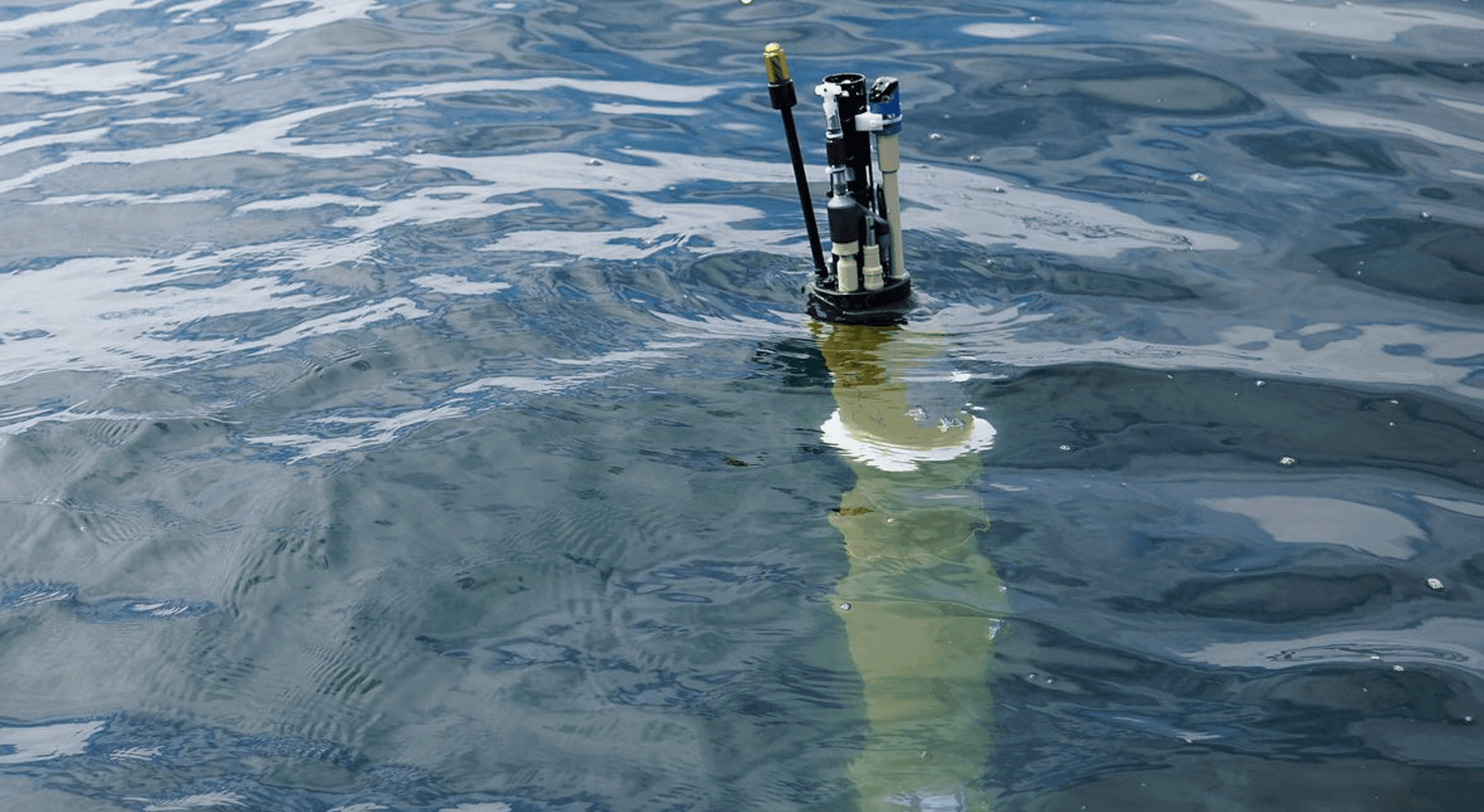
In the silent depths beneath the ocean’s surface, hundreds of autonomous “biogeochemical” profiling floats drift, dive, and rise—quietly recording the planet’s vital signs.
These free-floating robots, deployed under the Global Ocean Biogeochemical Array (GO-BGC) led by MBARI, are redefining how scientists measure ocean health and track carbon storage in real time.
Recent findings published in Nature Communications show that marine heatwaves are weakening the ocean’s natural carbon sequestration—its ability to transport and store carbon in the deep sea for centuries. The discovery was possible thanks to a global fleet of robotic profilers that can dive up to 2,000 meters, collecting key chemical and biological data—including oxygen, nitrate, chlorophyll, and pH—every ten days.
“I describe them as measuring the metabolism of the ocean,” says Ken Johnson, MBARI Senior Scientist and lead investigator for GO-BGC. “They take the ocean’s vital signs, just like a doctor would.”
Each robot operates autonomously, adjusting its buoyancy to move through the water column while recording changes in chemistry and biology. Once it surfaces, it transmits the data via Iridium satellites, sharing results publicly within 24 hours. More than 330 MBARI-designed floats now operate worldwide, complementing the 4,000-strong Argo network established over two decades ago.
Revealing Hidden Climate Signals
Data collected by these robots show that prolonged marine heatwaves—like the 2013–2015 and 2019–2020 “Blobs” in the North Pacific—alter plankton ecosystems and disrupt the vertical transport of carbon.
In warmer conditions, organic matter decomposes faster and fails to sink deep enough to remain stored, releasing CO₂ back into the atmosphere sooner.
These shifts indicate that the ocean’s role as a carbon sink is not stable; it can be weakened by heat stress and ecological imbalance.
Continuous robotic observation now allows scientists to detect such subtle changes that traditional ship-based surveys—limited by time, cost, and weather—often miss.
“You can’t understand how the ocean responds to multiple heatwaves with a two-week cruise,” Johnson notes. “These robots keep recording year-round—even through storms and holidays.”
AI-Enhanced Ocean Monitoring
MBARI researchers are also applying machine learning to interpret massive datasets generated by these floats.
A recent study in Global Biogeochemical Cycles used neural networks to show rising nitrate production across the Southern Ocean, a critical region for global carbon and nutrient cycling.
Each robot is engineered to last up to seven years—completing about 250 vertical profiles—making them among the most durable and cost-effective tools for long-term ocean monitoring.
Their modular design, aluminum pressure hulls, and smart sensor arrays make them ideal for scaling global climate observation without human risk or constant maintenance.
Toward a Smarter Ocean Guardian Network
As the world races to understand and protect marine ecosystems under climate stress, autonomous profiling robots are emerging as essential instruments for blue-planet resilience.
They bridge the gap between satellite observation and ship-based expeditions, providing continuous insight into carbon cycles, nutrient transport, and heat absorption.
However, the program’s future remains uncertain.
The US $53 million NSF grant that built the U.S. BGC-Argo fleet expires this year, and continuation funding has yet to be secured.
Without support, this critical ocean-monitoring infrastructure could face disruption—just as its findings are becoming indispensable for global climate modeling and marine protection.










Leave a comment