



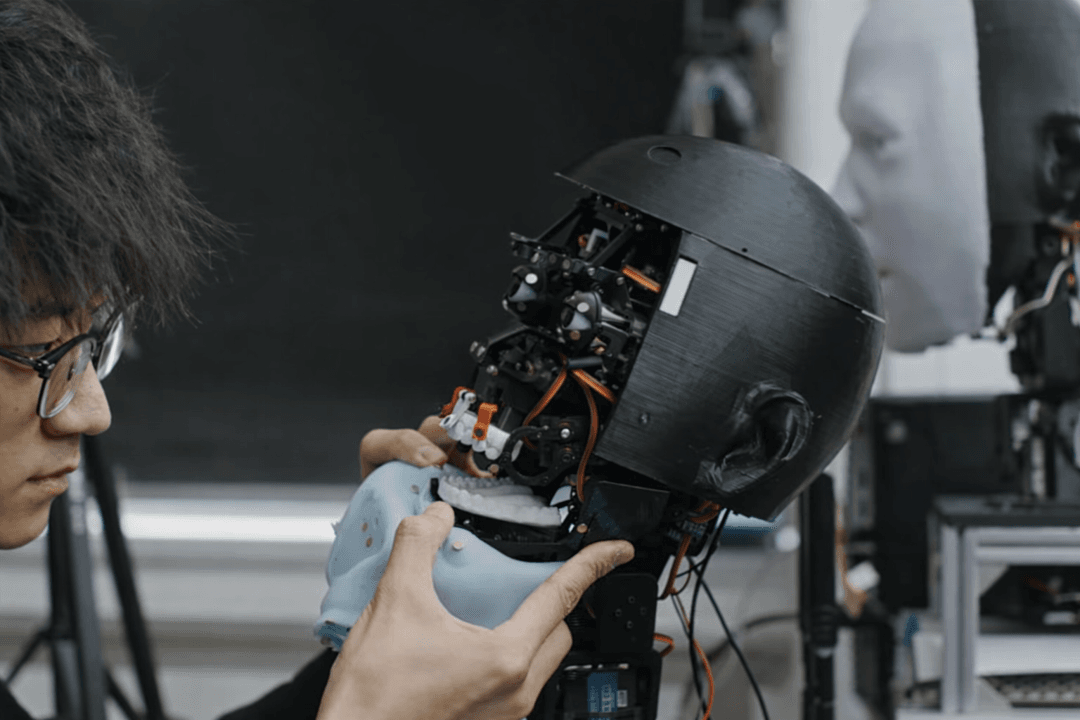
Why facial biomimicry is second only to dexterous hands in difficulty
Abstract
On January 14, 2026, Columbia University's Creative Machines Lab published groundbreaking Emo robot research in Science Robotics (lead author: Dr. Yuhang Hu; senior author: Professor Hod Lipson), marking a paradigm shift in humanoid facial expression technology. This paper systematically analyzes why facial biomimicry is second only to dexterous hands in difficulty, and how the field is evolving from "face replacement" to "brain replacement," through three dimensions: technical architecture, engineering challenges, and industrial pathways.
I. Core Proposition: Why is Facial Biomimicry So Difficult?
1.1 Three Dimensions of Complexity
Physical Dimension: Ultra-High Density Integration
The human face contains 43 facial muscles capable of producing over 10,000 micro-expression combinations. In contrast, while the human hand has 27 bones and 34 muscles, its movements primarily serve macro tasks like grasping. The face must simultaneously achieve within approximately 15cm² of head space:
- Micron-level precision control: Eyelid opening is only 2-3mm, yet directly impacts emotional communication
- Multi-system coupling: Lip synchronization requires coordinating at least 4 subsystems: lips, tongue, jaw, and cheeks
- Dynamic skin properties: Skin must complete elastic deformation from neutral to smile within 0.3 seconds
Perceptual Dimension: The Uncanny Valley Lock-in
Research shows human perception is highly attuned to facial features, with specialized brain circuits dedicated to processing facial expressions and detecting subtle deviations. When biomimicry reaches the 85%-95% range, minor flaws (such as 0.5-second lip sync delays or asymmetric blinking) trigger strong discomfort. Studies have demonstrated that the uncanny valley effect is stronger for faces compared to other body parts like hands or legs. This "almost but not quite human" state makes facial biomimicry an "all or nothing" extreme challenge.
Intelligence Dimension: Paradigm Shift from Rules to Learning
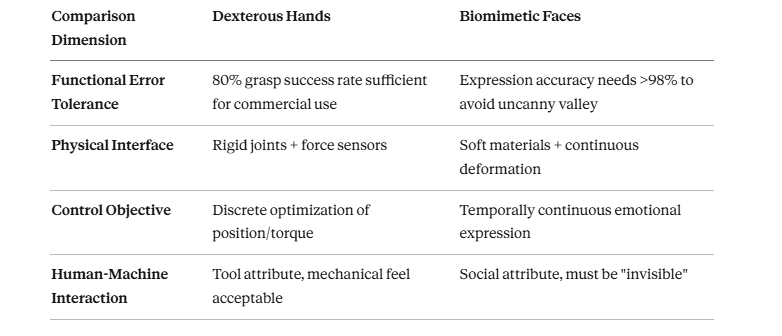
Traditional dexterous hands can be controlled through inverse kinematics solutions, but facial expressions are deeply bound to language, emotion, and culture. For example:
- The same phoneme produces different lip shapes across languages
- Smiles activate different muscle patterns in Eastern versus Western cultures
- Expression transition trajectories during mixed emotions (like "surprise with doubt")
This requires systems to possess cross-modal learning capabilities, not simple mechanical mapping.
1.2 Fundamental Differences from Dexterous Hands
II. The Emo Breakthrough: From "Face Replacement" to "Brain Replacement" Revolution
2.1 Three Fatal Flaws of Traditional Approaches
Flaw 1: Rule Explosion
Early approaches used viseme-phoneme mapping (linking phonemes to preset lip shapes), but:
- English's 44 phonemes require manually tuning thousands of rules
- Cross-language transfer requires re-annotation (Chinese tonal variations, Arabic gutturals)
- Rule conflicts during emotional overlay (like "saying a joke sadly")
Flaw 2: Hardware Arms Race
Commercial companies attempted to solve problems with more motors:
- AheadForm: 30+ micro-motors
- Engineered Arts (Ameca): High-precision servo systems
- But this led to: ①spatial conflicts (motors interfering), ②noise disaster (30 motors running simultaneously), ③cost explosion (single head >$50,000)
Flaw 3: Static Optimization Ceiling
Even after initial calibration, silicone aging, temperature changes, and long-term wear cause performance drift, requiring continuous manual recalibration.
2.2 Emo's Paradigm Breakthrough: Self-Supervised Learning Pipeline
The Columbia team unveiled the Emo biomimetic robot head prototype. Through a self-supervised learning pipeline combining a Variational Autoencoder (VAE) with a Facial Action Transformer, the robot autonomously mastered natural lip synchronization in the New York laboratory without manual rule presetting, using only mirror self-observation and video imitation learning. This breakthrough directly addresses the "uncanny valley effect" bottleneck that humanoid robots face when entering elderly care and companionship scenarios. Featuring soft silicone lips actuated by a 10-degree-of-freedom mechanism, Emo achieved a leap from "discrete splicing" to "continuous motion trajectories" through learning-based compensation. Core Innovation 1: Mirror Self-Observation
The robot observes its reflection in a mirror to establish a self-supervised mapping between "desired actions" and "actual actuator outputs." This gives the robot proprioceptive ability, allowing it to adapt to hardware drift and material aging over time.
Core Innovation 2: Video Imitation Learning
- Collects hours of human speaking and singing videos from platforms like YouTube
- Uses Variational Autoencoder (VAE) to extract continuous lip shape feature streams
- Predicts 0.5-second future muscle trajectories through Facial Action Transformer
Technical Advantages:
- Language-Agnostic: Demonstrates generalization across 10 unseen languages (including Chinese, French, Arabic)
- Emotional Generalization: Successfully synthesized singing expressions for AI album "hello world_"
- Adaptive Learning: Continuously improves through observation, adapting to hardware changes over time
III. Four Engineering Bottlenecks and Solution Pathways
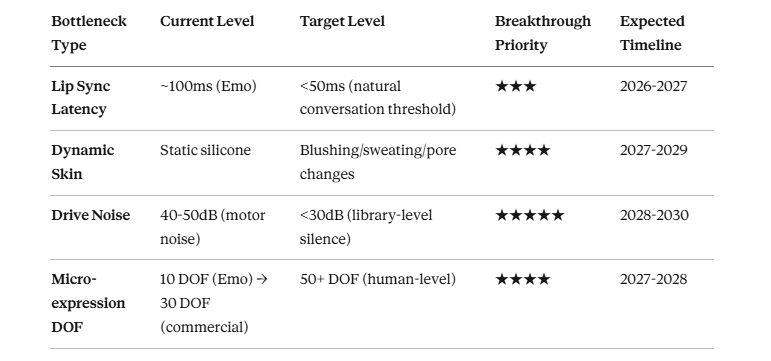
3.1 Bottleneck Matrix Analysis
3.2 Key Technical Routes
Route A: Intelligence-First Approach (Columbia Emo)
- Philosophy: "Use algorithms to compensate for hardware limitations"
- Method: 10 degrees of freedom generate continuous trajectories through deep learning, using soft materials and learning to compensate for mechanical simplicity
- Advantages: Lower cost, scalable, strong language/cultural adaptability
- Disadvantages: Ultimate expressiveness limited by physical DOF
Route B: Hardware-First Approach (AheadForm/Engineered Arts)
- Philosophy: "Precision engineering first, using physical limits to approach human capability"
- Method: 30+ motors + anatomical-grade skin + thermal regulation systems
- Advantages: Most impressive current demonstration effects, commercially viable for exhibitions
- Disadvantages: High cost, loud noise, poor cross-scenario generalization
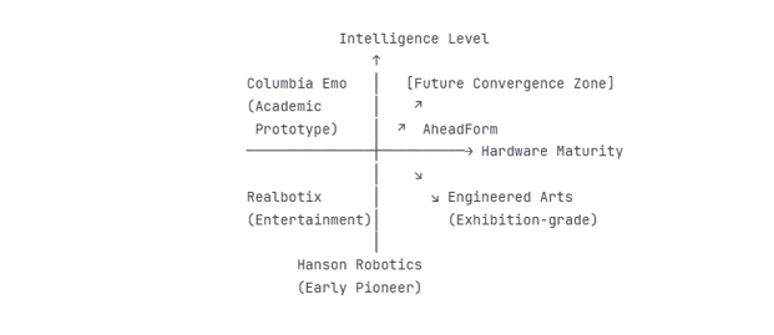
Future Convergence Direction: Industry consensus is forming—licensing Emo's learning algorithms to high-DOF hardware platforms, achieving dual breakthroughs in "intelligent driving + physical limits." Commercial teams like AheadForm are exploring this path.
IV. Industry Landscape: Deep Integration of Academia and Commerce
4.1 Global Player Positioning Map
4.2 Commercialization Tipping Point Analysis
Cost Reduction Roadmap
Current biomimetic facial technology stands at a critical transition from laboratory to market. Columbia's Emo prototype costs approximately $80,000 per head: actuators ($35,000), silicone skin ($15,000), computing platform ($20,000), and R&D labor ($10,000). This price cannot support commercial deployment. Industry consensus targets $8,000 per unit by 2028—a 10-fold reduction. Three breakthroughs are needed: standardized actuator modules replacing custom components, optimized global supply chains leveraging cost-advantaged manufacturing, and economies of scale when production exceeds 100,000 units annually.
Priority Application Scenarios
Elderly Care: The Primary Market
Global aging creates a $50+ billion market by 2030. The core need is emotional companionship, not functional tasks. Elderly people living alone need "virtual family members" for natural conversation and empathetic responses—the killer application for biomimetic faces. Success requires both fluent dialogue and nuanced expressions; weakness in either breaks the experience.
Medical Rehabilitation: The Transition Market
This field tolerates technical imperfection. Autism social training doesn't require "indistinguishable from real" robots; moderate mechanical feel may reduce patient anxiety. Stroke rehabilitation emphasizes standardized expression patterns over emotional depth. This provides early revenue and clinical data while technology matures.
Service Industry: The Ultimate Challenge
Hotel desks and museum guides demand 24-hour operation, making noise and durability critical. Current motors produce 40-50 decibels during sustained use—harsh in quiet spaces. Silicone degrades after 8 hours of deformation, affecting naturalness. Only artificial muscle technology and fatigue-resistant materials enable scalable deployment here.
V. Ethics and Strategic Recommendations
5.1 Labor Market Disruption and Workforce Transition
The maturation of biomimetic facial technology will directly impact the labor market. Workers in emotional labor positions such as caregivers and customer service face a practical problem: when machines can provide more stable emotional companionship, traditional occupational advantages will quickly disappear. This is not simply an unemployment issue, but a social issue involving the livelihoods of millions. Policymakers need to establish skill transition support mechanisms, while enterprises should explore human-machine collaboration models—robots handle repetitive work, humans focus on complex emotional decisions.
5.2 Technology Misuse and Trust Protection
The risk of technology misuse is equally serious. Super-realistic biomimetic faces could become tools for fraud and misinformation dissemination, especially during sensitive periods. The core challenge of regulation is balancing innovation with security. A feasible solution is requiring all biomimetic robots to have clear identification markers, such as illuminated badges on foreheads, allowing immediate recognition in public spaces. This is not restricting technology, but protecting the social trust system.
5.3 Cultural Diversity Preservation
The hazard to cultural diversity is more hidden. If training data over-relies on specific regions, products will erode the richness of global cultural expressions. Japanese restrained smiles, Mediterranean exaggerated gestures, Middle Eastern eye contact customs—these differences constitute the diversity of human civilization. Technology developers have a responsibility to establish datasets covering major global cultural spheres, preventing algorithms from becoming amplifiers of single standards.
5.4 Strategic Priorities for Key Stakeholders
For academia, the key is open-sourcing core algorithms to avoid redundant research. For industry, consensus on hardware standardization is needed to reduce supply chain costs. For investors, judgment criteria should focus on "software-hardware integration" capability; companies betting solely on algorithms or hardware will become passive within 2-3 years.
VI. Conclusion: The Last Mile to Reality
6.1 Current Progress: The 70% Achievement
Current super-biomimetic robots have achieved 70-80% credibility in controlled environments. Basic lip synchronization covers ten languages, large expression transitions achieve natural continuity, and emotional expression in static scenarios can fool most observers. But there remains a fundamental gap from "indistinguishable anytime, anywhere."
6.2 The Final 30%: Four Critical Barriers
This final 30% concentrates on four difficulties. Dynamic skin features: real human faces show vascular engorgement, sweating, and pore changes with emotions, while current silicone only provides static texture. Micro-expression control: 0.2-second eyebrow twitches and eye corner contractions require 50+ degrees of freedom to reproduce. Drive noise: the most advanced motor arrays still produce 40-50 decibels during sustained operation; only transitioning to artificial muscle technology can achieve true silence. Long-term consistency: after 8 hours of continuous operation, silicone elasticity degrades and expression naturalness declines.
6.3 Timeline and Societal Impact
The timeline requires cautious optimism. Under current technological acceleration, combined with breakthroughs in new materials and edge AI chips, 2028-2030 may see the first commercial product passing the "Turing Expression Test"—where over half of human observers cannot identify it as a robot during 5-minute interactions. This will be another fundamental impact on society by artificial intelligence, following ChatGPT.
6.4 Philosophical Implications
As Professor Hod Lipson says: "We must slow down and think carefully." Because when machines possess faces indistinguishable from humans, our understanding of "humanity" itself will be redefined. On the road to pursuing ultimate biomimicry, we must continually ask: What exactly do we want to create? And how will these creations change us?
Reference
[1] Yuhang Hu, Jiong Lin, Judah Allen Goldfeder, et al. (2026). "Learning realistic lip motions for humanoid face robots." Science Robotics, 11(110), eadx3017. DOI: 10.1126/scirobotics.adx3017 [2] AheadForm Official Website: https://www.aheadform.com/ [3] Engineered Arts - Mesmer Technology: https://engineeredarts.com/robots/mesmer [4] Deepali Kishnani (2025). "The Uncanny Valley: An Empirical Study on Human Perceptions of AI-Generated Text and Images." MIT Master's Thesis. https://dspace.mit.edu/handle/1721.1/159096

Leave a comment